Navigating the 2026 U.S. National Debt: Economic Impact and Future Strategies
Anúncios
Navigating the 2026 U.S. National Debt: Economic Impact and Future Strategies
The United States, a global economic powerhouse, consistently faces complex fiscal challenges. Among these, the national debt stands as a monumental and ever-evolving issue. As we project forward to 2026, understanding the trajectory, implications, and potential strategies for managing the 2026 US Debt becomes paramount. This comprehensive article delves into the intricacies of America’s national debt, offering an in-depth analysis of its current state, future forecasts, economic consequences, and the array of policy options available to navigate this fiscal landscape.
The national debt, often a topic of fervent political debate and economic scrutiny, represents the total accumulation of past deficits—the difference between government spending and revenue—over the nation’s history. It is not merely a number but a reflection of economic policies, historical events, and societal priorities. By 2026, projections suggest that this figure will reach unprecedented levels, raising critical questions about sustainability, economic stability, and intergenerational equity.
Anúncios
Our exploration will begin by defining the national debt and distinguishing it from the annual budget deficit. We will then examine the primary drivers contributing to its growth, including government spending on social programs, defense, interest payments, and tax policies. A significant portion of this analysis will be dedicated to forecasting the expected size of the 2026 US Debt and the underlying assumptions behind these projections. Understanding these foundational elements is crucial before we can assess the potential economic ramifications.
The economic consequences of a burgeoning national debt are multifaceted and can range from subtle shifts in market dynamics to more profound impacts on inflation, interest rates, economic growth, and the nation’s global standing. We will dissect concepts such as ‘crowding out,’ the burden of interest payments, and the potential for fiscal crises. Furthermore, we will explore how a high debt-to-GDP ratio can affect future generations, limiting their economic opportunities and increasing their tax burden.
Anúncios
Finally, this article will pivot to potential solutions and strategic approaches. This section will cover a spectrum of policy options, including fiscal consolidation through spending cuts and tax increases, the role of economic growth, monetary policy considerations, and the importance of political will and bipartisan cooperation. The aim is to provide a holistic view of the challenges and opportunities associated with managing the 2026 US Debt, fostering a more informed public discourse on one of the most critical economic issues of our time.
Understanding the U.S. National Debt: Definitions and Drivers
Before delving into the specifics of the 2026 US Debt, it is essential to establish a clear understanding of what the national debt entails and what factors contribute to its expansion. The U.S. national debt, often referred to as public debt, is the total amount of money the U.S. federal government owes to its creditors, both domestic and foreign. This debt accumulates from years of budget deficits, where government expenditures exceed its revenues. When the government spends more than it collects in taxes and other income, it must borrow to cover the difference, thereby adding to the national debt.
Distinguishing Debt from Deficit
It’s crucial not to confuse the national debt with the budget deficit. The budget deficit is an annual measure: it’s the difference between government spending and revenue in a single fiscal year. The national debt, on the other hand, is the cumulative sum of all past deficits (minus any surpluses). A persistent annual deficit inevitably leads to an increase in the national debt.
Key Drivers of the National Debt
Several significant factors contribute to the growth of the U.S. national debt. These drivers are often interconnected and can be influenced by economic cycles, demographic shifts, and policy choices:
- Mandatory Spending: This category includes entitlement programs like Social Security, Medicare, and Medicaid. These programs constitute a substantial and growing portion of the federal budget, largely due to an aging population and rising healthcare costs. As the baby boomer generation retires and lives longer, the outlays for these programs are projected to increase significantly, placing upward pressure on the debt.
- Discretionary Spending: This refers to spending that Congress appropriates annually, such as defense, education, transportation, and scientific research. While theoretically more flexible, political priorities and national security needs often lead to substantial allocations in these areas. Defense spending, in particular, has historically been a major contributor to the debt, especially during periods of conflict.
- Interest Payments on the Debt: As the national debt grows, so do the interest payments the government must make to its creditors. These payments are a mandatory expense and can consume a significant portion of the federal budget, reducing funds available for other priorities. Rising interest rates can exacerbate this problem, leading to an even faster escalation of debt servicing costs.
- Tax Policy: Government revenue is primarily generated through taxes. Tax cuts, unless offset by corresponding spending reductions or significant economic growth, can lead to larger deficits and an increase in the national debt. Conversely, tax increases can help reduce the deficit, but they can also be politically unpopular and potentially impact economic activity.
- Economic Downturns and Crises: Recessions, financial crises, and public health emergencies (like the COVID-19 pandemic) often necessitate increased government spending on unemployment benefits, stimulus packages, and other relief efforts, while simultaneously reducing tax revenues. This combination typically leads to a sharp increase in the national debt.
- Demographic Shifts: Beyond the aging population impacting entitlement programs, slower population growth and declining birth rates can also affect the debt. A smaller working-age population relative to retirees means fewer taxpayers contributing to the system and more beneficiaries drawing from it.
Understanding these drivers is the first step in comprehending the scale and persistence of the national debt challenge. Each factor presents its own set of policy dilemmas and trade-offs, making comprehensive debt management a complex undertaking.
Forecasting the 2026 US Debt: Projections and Assumptions
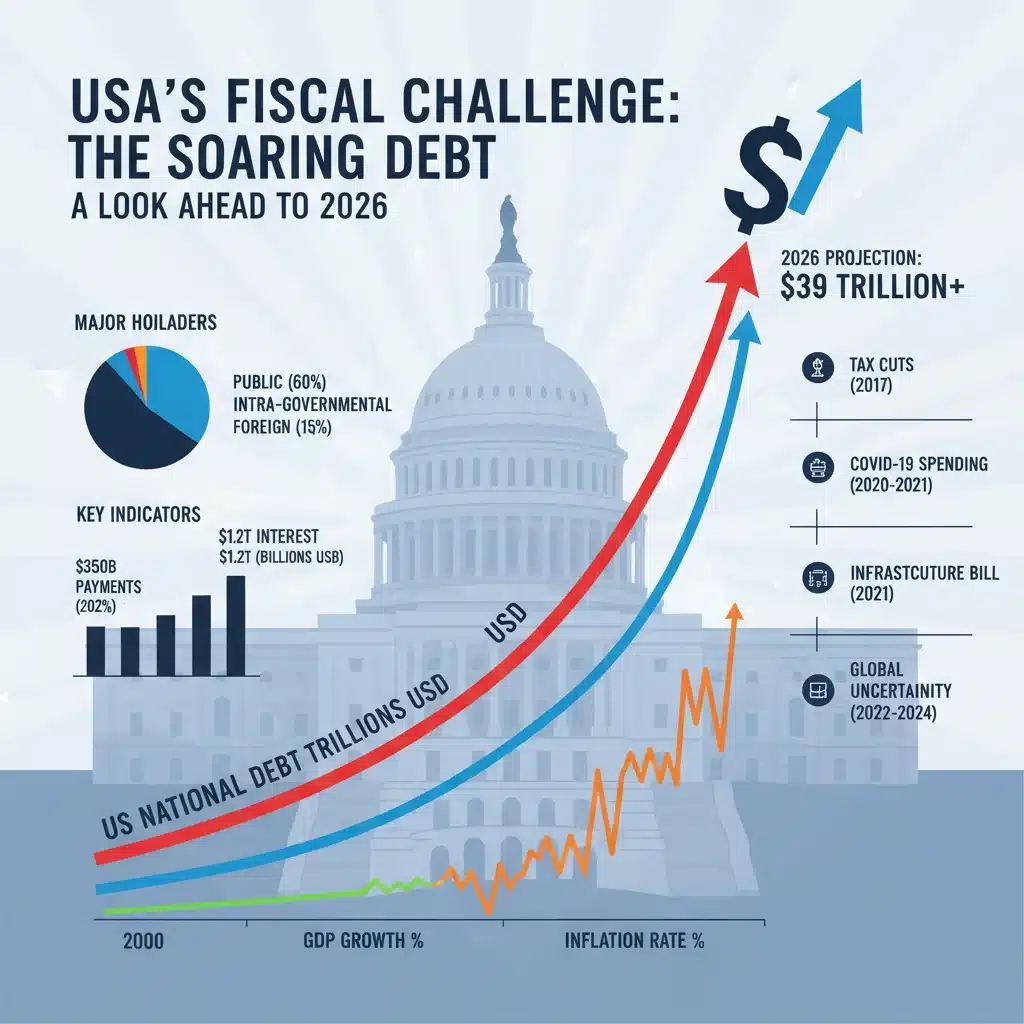
Predicting the exact size of the 2026 US Debt is a challenging endeavor, as it depends on a multitude of variables, including economic growth rates, inflation, interest rates, and future legislative actions. However, various governmental and independent organizations, such as the Congressional Budget Office (CBO) and the Office of Management and Budget (OMB), provide detailed projections that offer valuable insights into the likely trajectory of the national debt.
Current Trajectory and CBO Projections
The U.S. national debt has been on an upward trend for decades, accelerating significantly in response to major economic crises and policy shifts. As of recent reports, the total public debt outstanding is already in the tens of trillions of dollars. The CBO, known for its non-partisan economic analysis, routinely publishes long-term budget outlooks that project federal spending, revenues, deficits, and debt under current law.
These projections typically indicate that the national debt, both in absolute terms and as a percentage of Gross Domestic Product (GDP), will continue to rise. For 2026, the CBO’s baseline projections often show the debt held by the public reaching well over 100% of GDP. This is a critical metric, as it compares the nation’s debt burden to its total economic output, providing a measure of the country’s capacity to service its debt.
Key Assumptions Underpinning Projections
The accuracy of these forecasts hinges on several key assumptions. Changes in any of these variables can significantly alter the projected size of the 2026 US Debt:
- Economic Growth Rates: Stronger economic growth can lead to higher tax revenues and lower spending on certain safety-net programs, thereby reducing deficits. Conversely, slower growth or a recession can exacerbate the debt problem. Projections usually assume a moderate, steady rate of economic expansion.
- Inflation: Moderate inflation can erode the real value of the debt over time, making it easier to repay. However, high, uncontrolled inflation can destabilize the economy. Forecasts typically include an assumption about future inflation rates, often tied to the Federal Reserve’s targets.
- Interest Rates: This is a crucial factor. As the national debt grows, even small increases in interest rates can significantly increase the cost of servicing that debt. Projections consider the Federal Reserve’s likely monetary policy and market expectations for interest rates on government bonds.
- Fiscal Policy (Spending and Revenue): The CBO’s baseline projections typically assume that current laws governing spending and taxes remain unchanged. Any new legislation — such as tax cuts, new spending programs, or reforms to entitlement programs — would alter these projections.
- Demographic Trends: Assumptions about birth rates, mortality rates, and immigration patterns directly impact the future costs of Social Security and Medicare. An aging population generally implies higher outlays for these programs.
It’s important to remember that these projections are not guarantees but rather informed estimates based on current trends and specific assumptions. Unforeseen events, such as another global pandemic, a major geopolitical conflict, or a severe economic shock, could dramatically alter the fiscal outlook for 2026 and beyond.
The sheer magnitude of the projected 2026 US Debt underscores the urgency of addressing this issue. While the U.S. has historically managed high levels of debt, the current trajectory, combined with rising interest rates and demographic pressures, presents unique challenges that demand careful consideration and proactive policy responses.
Economic Consequences of a High 2026 US Debt
The implications of a substantial and growing national debt extend far beyond mere numbers on a balance sheet. A high 2026 US Debt can exert profound and wide-ranging effects on the economy, impacting everything from individual households to the nation’s global standing. Understanding these consequences is vital for appreciating the urgency of fiscal responsibility.
Increased Interest Payments and Fiscal Strain
One of the most immediate and tangible consequences of a large national debt is the increasing cost of servicing that debt. As the debt grows, so do the interest payments the government must make to bondholders. These payments are mandatory and take precedence over other spending priorities. A significant portion of the federal budget is already allocated to interest payments, and this share is projected to rise as the 2026 US Debt expands and interest rates potentially increase.
This fiscal strain means less money is available for other critical public investments, such as infrastructure, education, research, and defense. It can lead to difficult choices, forcing policymakers to either cut essential programs, raise taxes, or borrow even more, thereby perpetuating the debt cycle. The opportunity cost of these interest payments is substantial, representing resources that could otherwise be used to foster long-term economic growth and improve societal well-being.
"Crowding Out" Private Investment
A frequently cited concern associated with high national debt is the phenomenon known as "crowding out." When the government borrows heavily to finance its debt, it competes with the private sector for available savings. This increased demand for loanable funds can drive up interest rates. Higher interest rates, in turn, make it more expensive for businesses to borrow money for investments in new equipment, technology, and expansion. This can stifle private sector growth, reduce innovation, and ultimately lead to slower economic expansion and fewer job opportunities.

Inflationary Pressures and Monetary Policy Challenges
While not an immediate certainty, a persistently high national debt can, under certain circumstances, contribute to inflationary pressures. If the central bank (the Federal Reserve in the U.S.) is perceived as being pressured to monetize the debt — essentially printing money to buy government bonds — it could lead to an excessive increase in the money supply, driving up prices. Even without direct monetization, if bond markets lose confidence in the government’s ability to manage its debt, they might demand higher yields, which can translate into higher borrowing costs across the economy and potentially fuel inflation.
A large debt also complicates monetary policy. If the Fed needs to raise interest rates to combat inflation, a higher debt burden means the government’s interest payments will surge, making such a move politically and fiscally challenging. This can create a conflict between the Fed’s dual mandate of stable prices and maximum employment, and the government’s fiscal realities.
Reduced Fiscal Flexibility in Future Crises
A high 2026 US Debt significantly reduces the government’s fiscal flexibility to respond to future economic downturns, natural disasters, or national security threats. In times of crisis, governments often need to increase spending dramatically (e.g., stimulus packages, disaster relief) and may experience a fall in tax revenues. If the national debt is already at elevated levels, the capacity to borrow more without triggering a loss of market confidence or a sharp rise in interest rates is severely constrained. This limited fiscal space can prolong recessions and exacerbate the impact of unforeseen events.
Intergenerational Equity and Future Burden
Perhaps one of the most ethically charged consequences of a rising national debt is the issue of intergenerational equity. Current generations who benefit from government spending financed by borrowing are essentially passing the bill to future generations. These future taxpayers will face a higher tax burden, reduced public services, or both, to service the accumulated debt. This transfer of financial obligation can limit the economic opportunities and living standards of future generations, creating a moral imperative for responsible fiscal management today.
Impact on International Standing and Investor Confidence
While the U.S. dollar maintains its status as the world’s primary reserve currency, and U.S. Treasury bonds are considered among the safest investments globally, a continuously escalating national debt could, over the very long term, erode international investor confidence. If investors perceive a heightened risk of default (however remote for the U.S.) or a significant depreciation of the dollar due to fiscal mismanagement, they might demand higher interest rates to lend to the U.S. government. This could weaken the dollar, make imports more expensive, and potentially diminish America’s economic and geopolitical influence.
In summary, the economic consequences of a large and growing 2026 US Debt are profound and multifaceted. They threaten fiscal stability, can stifle economic growth, complicate monetary policy, and impose a significant burden on future generations. Addressing this challenge requires a clear understanding of these ramifications and a commitment to sustainable fiscal policies.
Strategies for Managing the 2026 US Debt
Addressing the growing 2026 US Debt requires a multi-pronged approach involving a combination of fiscal, monetary, and economic growth strategies. There is no single, easy solution, and effective debt management often necessitates difficult political choices and bipartisan cooperation.
Fiscal Consolidation: Spending Cuts and Revenue Increases
The most direct way to reduce the national debt is through fiscal consolidation, which involves either decreasing government spending or increasing government revenues, or both. This approach directly tackles the annual budget deficit, which is the root cause of debt accumulation.
- Spending Cuts: This can involve reducing discretionary spending across various government agencies, reforming entitlement programs (such as Social Security and Medicare) to slow their growth, or re-evaluating defense expenditures. Cutting spending is often politically challenging, as it impacts various constituencies and can face strong opposition. However, targeted and efficient spending reductions can free up resources and signal fiscal discipline.
- Revenue Increases: This typically involves raising taxes. Options include increasing income tax rates, broadening the tax base, implementing new taxes (e.g., a carbon tax), or reforming corporate taxes. Like spending cuts, tax increases are often unpopular but can be a powerful tool for deficit reduction. The challenge lies in designing tax policies that generate sufficient revenue without unduly hindering economic growth or disproportionately burdening certain segments of the population.
- Waste and Efficiency: While not a panacea, identifying and eliminating waste, fraud, and inefficiency within government programs can contribute to deficit reduction. Streamlining operations and improving the effectiveness of public services can yield savings, albeit often incremental compared to the scale of the overall debt.
Promoting Economic Growth
Sustainable economic growth is a powerful, albeit indirect, tool for debt management. A growing economy leads to higher national income, which in turn generates more tax revenue for the government without necessarily raising tax rates. It also improves the debt-to-GDP ratio, making the existing debt more manageable relative to the country’s economic capacity.
Policies aimed at fostering long-term economic growth include:
- Investment in Infrastructure: Modernizing roads, bridges, public transit, and digital infrastructure can boost productivity and create jobs.
- Education and Workforce Development: Investing in human capital through education, job training, and skills development can lead to a more productive workforce and higher wages.
- Research and Development: Government support for basic and applied research can spur innovation, leading to new industries and technologies.
- Regulatory Reform: Streamlining regulations that are burdensome without providing significant public benefit can encourage business investment and entrepreneurship.
- Trade Policies: Promoting free and fair trade can open new markets for U.S. goods and services, fostering economic expansion.
While economic growth is desirable, it is often not sufficient on its own to address a rapidly growing debt, especially if underlying structural deficits persist.
Monetary Policy and Debt Management
While fiscal policy (government spending and taxation) is the primary tool for debt management, monetary policy (managed by the Federal Reserve) plays an important supporting role. Low and stable interest rates can reduce the cost of servicing the national debt. However, the Fed’s primary mandates are price stability and maximum employment, not debt management. If the Fed keeps interest rates artificially low to help the government, it risks fueling inflation. Conversely, if the Fed raises rates to combat inflation, it increases the government’s interest burden.
Therefore, coordination between fiscal and monetary authorities is crucial. Fiscal policy should aim for sustainability, allowing the Fed to pursue its mandates without being overly constrained by debt concerns.
Political Will and Bipartisan Cooperation
Ultimately, managing the 2026 US Debt requires significant political will and a commitment to bipartisan cooperation. The decisions involved often entail short-term sacrifices for long-term gains, which can be challenging in a highly polarized political environment. Comprehensive debt reduction plans typically involve compromises across various political ideologies, touching on sensitive areas like social programs, defense spending, and taxation.
A national consensus on the importance of fiscal sustainability, coupled with a willingness from both sides of the political spectrum to negotiate and implement difficult reforms, is perhaps the most critical component for effective debt management.

Debt Restructuring and Default (Extreme Scenarios)
In extreme, hypothetical scenarios, a nation facing an unsustainable debt burden might consider debt restructuring or even default. Debt restructuring involves renegotiating the terms of debt repayment with creditors (e.g., extending maturities, reducing interest rates). Default, where a government fails to meet its debt obligations, is an even more severe outcome. For a country like the United States, with its strong institutions, robust economy, and global reserve currency status, these options are considered highly improbable and would have catastrophic consequences for the global financial system and America’s international standing. Therefore, the focus remains firmly on proactive fiscal and economic strategies to avoid such dire scenarios.
The path to a more sustainable fiscal future for the U.S. is undoubtedly challenging. It requires a clear-eyed assessment of the problem, a commitment to long-term planning, and the courage to implement policies that may not be immediately popular but are essential for the nation’s economic health and the well-being of future generations. The discussion around the 2026 US Debt is not just about numbers; it’s about the kind of economic future the United States is building.
The Global Context: International Comparisons and Influences on the 2026 US Debt
Understanding the 2026 US Debt in isolation provides only part of the picture. The United States operates within a complex global economic framework, and its debt dynamics are influenced by, and in turn influence, international financial markets and other nations’ economies. Comparing the U.S. debt situation to that of other developed countries and considering global economic trends offers a broader perspective.
U.S. Debt in Comparison to Other Developed Nations
While the absolute size of the U.S. national debt is the largest in the world, comparing debt-to-GDP ratios provides a more accurate measure of a country’s debt burden relative to its economic capacity. Many developed countries, particularly Japan, several European nations, and some G7 members, also carry high debt-to-GDP ratios, some even higher than that of the United States.
- Japan: Consistently has the highest debt-to-GDP ratio among developed nations, often exceeding 250%. This is largely due to prolonged economic stagnation, an aging population, and extensive government spending to stimulate growth.
- European Union: Many EU member states, particularly those in the Eurozone, face significant debt challenges. Countries like Greece, Italy, and Portugal have historically high debt ratios, which have been a source of concern for the stability of the Eurozone. Germany, while fiscally conservative, also carries substantial debt.
- Other G7 Nations: Canada, the UK, and France also have considerable national debts, often influenced by similar factors as the U.S. – social welfare programs, defense spending, and responses to economic crises.
The U.S. often benefits from its unique position as the issuer of the world’s primary reserve currency. This status means there is a consistently high global demand for U.S. Treasury bonds, allowing the U.S. government to borrow at relatively lower interest rates than many other countries, even with a high debt burden. However, this advantage is not limitless, and persistent fiscal imbalances could eventually erode this privilege.
Global Economic Trends and Influences
Several global economic trends can impact the 2026 US Debt and its management:
- Global Interest Rates: If global interest rates rise, it can increase the cost of borrowing for the U.S. government, even if domestic factors are stable. International capital flows and investor sentiment play a significant role in determining bond yields.
- International Trade and Geopolitics: Global trade dynamics, supply chain disruptions, and geopolitical tensions can influence economic growth, inflation, and government spending (e.g., increased defense outlays), all of which affect the debt.
- Foreign Ownership of U.S. Debt: A substantial portion of U.S. national debt is held by foreign governments and investors. Changes in their investment strategies or economic conditions in their home countries can impact the demand for U.S. Treasury bonds and their yields. Major holders include China and Japan, among others.
- Global Crises: Future global pandemics, financial crises, or climate-related disasters could necessitate significant government intervention and spending, further increasing the national debt.
The Dollar’s Role and "Exorbitant Privilege"
The U.S. dollar’s role as the world’s reserve currency bestows upon the U.S. what former French Finance Minister Valéry Giscard d’Estaing termed an "exorbitant privilege." This means that the U.S. can finance its deficits more easily and at lower costs than other nations because of the global demand for dollars and dollar-denominated assets. This privilege provides a buffer, but it also carries a responsibility. If the U.S. were to consistently demonstrate fiscal irresponsibility, it could, over time, jeopardize the dollar’s reserve status, leading to a loss of this privilege and significantly higher borrowing costs.
Lessons from Other Nations
Observing how other countries manage their debt provides valuable lessons. For instance, some nations have implemented successful fiscal rules or independent fiscal councils to enforce budgetary discipline. Others have undertaken significant structural reforms to their entitlement programs or tax systems. While direct comparisons are challenging due to unique economic and political contexts, the experiences of other nations can inform U.S. policymaking.
Ultimately, the global context underscores that the 2026 US Debt is not just a domestic issue. It is intertwined with international finance, trade, and geopolitics. A fiscally stable United States contributes to global economic stability, while persistent fiscal challenges could have ripple effects far beyond its borders. Therefore, effective debt management strategies must consider both domestic imperatives and international realities.
Conclusion: Charting a Sustainable Fiscal Course for the 2026 US Debt and Beyond
The journey through the complexities of the 2026 US Debt reveals a fiscal landscape fraught with challenges but also opportunities for strategic action. As we have explored, the national debt is not merely an abstract figure; it is a profound indicator of economic health, a reflection of policy choices, and a determinant of future prosperity. Its projected trajectory to unprecedented levels by 2026, driven by mandatory spending, interest payments, and discretionary outlays, necessitates urgent and thoughtful attention.
The economic consequences of a burgeoning debt are far-reaching. From the fiscal strain of escalating interest payments that divert resources from critical public investments, to the potential for "crowding out" private sector innovation and growth, the ramifications touch every corner of the economy. Furthermore, the specter of reduced fiscal flexibility in the face of future crises and the ethical considerations of intergenerational burden underscore the imperative for action. A high debt can also complicate monetary policy, potentially leading to inflationary pressures and, in the long run, could even impact the U.S.’s international standing and the dollar’s global dominance.
However, the situation is not insurmountable. A range of strategies, combining fiscal consolidation, economic growth initiatives, and a supportive monetary policy environment, can collectively pave the way for a more sustainable fiscal future. Fiscal consolidation, through a balanced approach to spending cuts and revenue increases, is fundamental to reining in annual deficits. Promoting robust, inclusive economic growth, driven by investments in infrastructure, education, and innovation, can naturally boost government revenues and improve the debt-to-GDP ratio.
Crucially, the success of any debt management strategy hinges on political will and bipartisan cooperation. The difficult choices required to address the 2026 US Debt transcend partisan divides and demand a shared commitment to the nation’s long-term economic well-being. Learning from international comparisons and recognizing the global context of the U.S. debt further enriches the policy debate, offering insights into both challenges and potential solutions implemented by other nations.
The conversation about the 2026 US Debt is not just an economic discussion; it is a conversation about the kind of future we are building for ourselves and for generations to come. It requires a willingness to confront difficult realities, to engage in constructive dialogue, and to implement courageous policies that prioritize long-term stability over short-term political expediency. By understanding the drivers, consequences, and potential solutions, policymakers, economists, and the public can collectively work towards charting a sustainable fiscal course, ensuring that the United States remains a beacon of economic strength and opportunity well beyond 2026.