Health Savings Accounts 2026: Contribution Limits, Benefits & Strategies

Anúncios
The Latest on Health Savings Accounts (HSAs) for 2026: Contribution Limits and Benefits
As we look ahead to 2026, understanding the nuances of Health Savings Accounts (HSAs) becomes increasingly critical for proactive financial and healthcare planning. HSAs are not just another savings vehicle; they represent a powerful, tax-advantaged tool designed to empower individuals to manage their healthcare costs effectively while simultaneously building a robust nest egg for the future. The landscape of healthcare finance is constantly evolving, and staying informed about the latest adjustments, particularly the HSA 2026 limits, is paramount for maximizing their substantial benefits.
Anúncios
For many, the concept of an HSA remains somewhat shrouded in complexity. Is it merely a savings account for medical bills? Or does it hold a deeper potential for long-term wealth accumulation? The answer lies in its unique structure, which combines immediate tax advantages with the flexibility of investment growth, making it an indispensable asset for those enrolled in high-deductible health plans (HDHPs). This comprehensive guide aims to demystify HSAs, providing clarity on the expected changes for 2026 and offering actionable strategies to leverage this powerful financial instrument.
Whether you’re a seasoned HSA user or just beginning to explore its possibilities, this article will serve as your definitive resource. We will delve into the projected HSA 2026 limits, explain the eligibility requirements, unpack the triple tax advantage that sets HSAs apart, and discuss how to strategically use your HSA for both immediate healthcare needs and future financial security. Our goal is to equip you with the knowledge needed to make informed decisions, optimize your contributions, and ultimately, enhance your overall financial well-being through the strategic use of your Health Savings Account.
Anúncios
Understanding the Foundation: What is a Health Savings Account (HSA)?
Before diving into the specifics of 2026, let’s establish a foundational understanding of what an HSA entails. A Health Savings Account is a tax-advantaged savings account that can be used for qualified medical expenses. It is available to individuals who are enrolled in a High-Deductible Health Plan (HDHP). The primary purpose of an HSA is to help individuals save for current and future healthcare costs, providing a unique blend of health coverage and investment potential.
Key Characteristics of an HSA:
- Tax-Deductible Contributions: Money you contribute to an HSA is tax-deductible, reducing your taxable income in the year of contribution.
- Tax-Free Growth: The funds in your HSA grow tax-free. This includes any interest earned or investment gains, similar to a 401(k) or IRA.
- Tax-Free Withdrawals: Withdrawals for qualified medical expenses are entirely tax-free. This is the cornerstone of the "triple tax advantage."
- Portability: The HSA belongs to you, not your employer. If you change jobs or health plans, your HSA goes with you.
- No "Use It or Lose It" Rule: Unlike Flexible Spending Accounts (FSAs), HSA funds roll over from year to year, accumulating over time.
- Investment Potential: Once your balance reaches a certain threshold, many HSA providers allow you to invest the funds in mutual funds, stocks, and other securities, further accelerating growth.
The combination of these features makes HSAs an incredibly powerful tool, not just for managing healthcare costs but also as a supplemental retirement savings vehicle. By understanding these fundamental characteristics, you can begin to appreciate the significant role HSAs play in a comprehensive financial strategy.
Projected HSA 2026 Limits: What to Expect
Each year, the Internal Revenue Service (IRS) adjusts the contribution limits for Health Savings Accounts to account for inflation. While the official HSA 2026 limits are typically released in the spring or summer of the preceding year (i.e., spring/summer 2025 for 2026), we can make educated projections based on historical trends and current inflation rates. It’s crucial to remember that these are projections, and the final numbers may vary slightly.
Understanding the Adjustment Process
The IRS uses specific inflation metrics, primarily the chained Consumer Price Index for All Urban Consumers (C-CPI-U), to determine the annual adjustments for various tax provisions, including HSA contribution limits and high-deductible health plan (HDHP) deductibles and out-of-pocket maximums. Given the inflationary environment of recent years, we have seen consistent increases in these limits. This trend is likely to continue into 2026, albeit potentially at a more moderate pace depending on economic conditions.
Projected HSA 2026 Limits (Individual and Family Coverage):
- Self-Only Coverage: For individuals with self-only HDHP coverage, the annual contribution limit is expected to see an increase. Based on current projections and historical inflation, we anticipate this limit to be in the range of approximately $4,300 to $4,400. (For context, the 2024 limit is $4,150, and the 2025 projected limit is around $4,300).
- Family Coverage: For individuals with family HDHP coverage, the annual contribution limit is also expected to rise. We project this limit to be in the range of approximately $8,700 to $8,900. (For context, the 2024 limit is $8,300, and the 2025 projected limit is around $8,750).
- Catch-Up Contributions: The catch-up contribution for individuals aged 55 and older remains unchanged by inflation adjustments and is set by statute. It is expected to remain $1,000 per year. This allows individuals nearing retirement to significantly boost their HSA savings.
These projected HSA 2026 limits are vital for financial planning. Maxing out your contributions each year is often recommended to take full advantage of the tax benefits and investment growth potential. We strongly advise consulting the official IRS guidance once it is released for the definitive 2026 figures.
Eligibility Requirements for an HSA in 2026
To contribute to an HSA, you must meet specific eligibility criteria set forth by the IRS. These criteria are designed to ensure that HSAs are used in conjunction with high-deductible health plans, promoting consumer engagement in healthcare spending decisions. The core requirements are expected to remain consistent for 2026.
Primary Eligibility Criteria:
- Enrollment in a High-Deductible Health Plan (HDHP): This is the most crucial requirement. For 2026, your HDHP must meet specific minimum deductible and maximum out-of-pocket thresholds. While the exact figures for 2026 will be released by the IRS, based on current trends, we can project the following:
- Minimum Deductible: Expected to be around $1,650 for self-only coverage and approximately $3,350 for family coverage. (2024 limits are $1,600 and $3,200, respectively).
- Maximum Out-of-Pocket: Expected to be around $8,300 for self-only coverage and approximately $16,700 for family coverage. (2024 limits are $8,050 and $16,100, respectively). These maximums include deductibles, co-payments, and co-insurance, but not premiums.
- No Other Health Coverage: Generally, you cannot be covered by any other health plan that is not an HDHP, with some exceptions (e.g., specific injury insurance, accident insurance, disability, dental care, vision care, or long-term care).
- Not Enrolled in Medicare: Once you enroll in Medicare, you are no longer eligible to contribute to an HSA. However, you can still use existing HSA funds for qualified medical expenses.
- Not Claimed as a Dependent: You cannot be claimed as a dependent on someone else’s tax return.
It’s important to verify that your health plan qualifies as an HDHP for HSA purposes. Your health insurance provider can confirm if your plan meets the IRS criteria. Failure to meet these eligibility requirements can result in penalties for excess contributions.
The Triple Tax Advantage: Unpacking HSA Benefits
The allure of the HSA lies in its unparalleled "triple tax advantage," a feature that distinguishes it from almost every other savings and investment vehicle. Understanding these three pillars of tax benefits is key to appreciating the true power of an HSA.
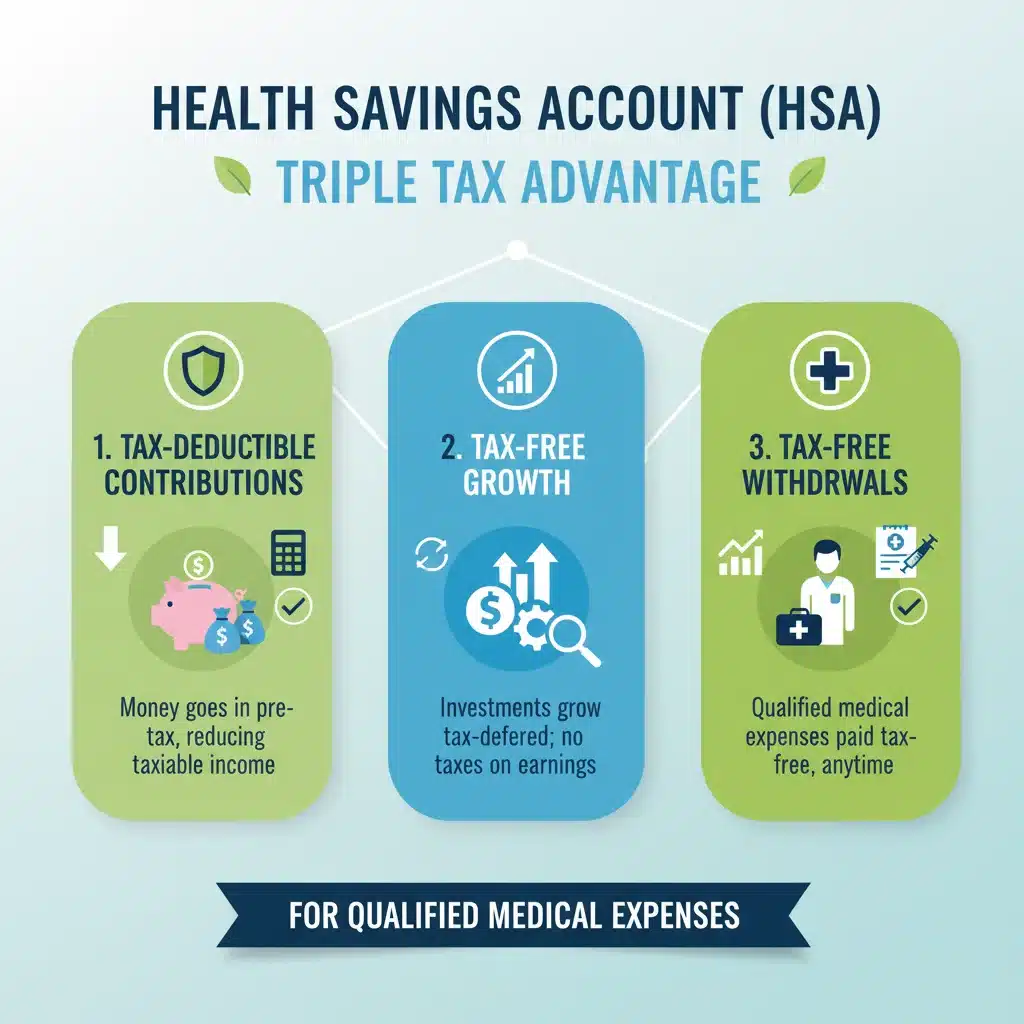
1. Tax-Deductible Contributions
Every dollar you contribute to your HSA is tax-deductible from your gross income. This means your taxable income is reduced by the amount you contribute, potentially lowering your current year’s tax bill. If your employer offers an HSA through payroll deductions, these contributions are often made pre-tax, meaning they also bypass FICA taxes (Social Security and Medicare), adding another layer of tax savings. This immediate tax break makes contributing to an HSA an attractive strategy from day one.
2. Tax-Free Growth
Once your contributions are in your HSA, they grow tax-free. This applies to any interest earned, dividends received, or capital gains from investments within the account. This compounding effect, unhindered by annual taxation, can significantly accelerate the growth of your savings over time. For those who treat their HSA as a long-term investment vehicle, this tax-free growth is a substantial benefit, similar to that offered by Roth IRAs or 401(k)s, but with an added layer of tax advantage on withdrawals.
3. Tax-Free Withdrawals for Qualified Medical Expenses
Perhaps the most powerful aspect of the HSA is that withdrawals used for qualified medical expenses are completely tax-free. This includes a wide array of expenses, from deductibles, co-pays, and prescriptions to dental care, vision care, and even certain over-the-counter medications. Unlike a traditional IRA or 401(k), where withdrawals in retirement are taxed, an HSA allows you to access your funds for healthcare needs without incurring any income tax, ever, provided they are for qualified medical expenses. This makes it an ideal vehicle for covering healthcare costs in retirement, which can be substantial.
It’s important to retain receipts for all qualified medical expenses, as you may need to prove to the IRS that your withdrawals were for legitimate healthcare costs if audited. The definition of "qualified medical expenses" is broad and generally follows IRS Publication 502.
Strategies for Maximizing Your HSA in 2026
To truly harness the power of your HSA, a strategic approach is essential. It’s not enough to simply open an account; optimizing your contributions and utilization can yield significant long-term financial benefits. Here are several strategies to consider for 2026:
1. Max Out Your Contributions Annually
Aim to contribute the maximum allowable amount each year, leveraging the projected HSA 2026 limits. This ensures you take full advantage of the tax deductions and maximize the funds available for tax-free growth. If you are 55 or older, remember to utilize the additional catch-up contribution. Consistent, maximum contributions are the bedrock of a robust HSA strategy.
2. Invest Your HSA Funds Aggressively (If Appropriate)
Once you have a comfortable cash reserve to cover immediate medical expenses, consider investing the remainder of your HSA funds. Many HSA providers offer a range of investment options, from low-cost index funds to more diversified portfolios. Since HSA funds can be carried over indefinitely and grow tax-free, investing allows your money to work harder for you over decades, potentially accumulating a substantial sum for future healthcare costs, especially in retirement.
3. Pay for Current Medical Expenses Out-of-Pocket
This might seem counterintuitive, but if you have the financial capacity, paying for current medical expenses out-of-pocket and allowing your HSA funds to continue growing tax-free is a powerful strategy. You can save your receipts and reimburse yourself tax-free from your HSA at any point in the future. This effectively turns your HSA into an ultra-flexible, tax-advantaged investment account, as your "reimbursement" can occur years or even decades later, after your investments have significantly grown.
4. Use Your HSA as a Retirement Savings Vehicle
Beyond its primary role in healthcare, the HSA is often dubbed the "ultimate retirement account." After age 65, you can withdraw HSA funds for any purpose without penalty, though non-medical withdrawals will be taxed as ordinary income (similar to a traditional IRA). This flexibility means that if you’ve managed to keep your medical expenses low or paid them out-of-pocket, your HSA can serve as a supplementary retirement fund, providing another stream of tax-advantaged income in your golden years.
5. Understand Qualified Medical Expenses
Familiarize yourself with what constitutes a "qualified medical expense" according to IRS Publication 502. This knowledge ensures your withdrawals remain tax-free and helps you plan for future healthcare needs. Examples include doctor visits, prescription medications, dental work, vision care, chiropractic services, and even certain long-term care insurance premiums.
HSA vs. FSA: Key Differences
While both Health Savings Accounts (HSAs) and Flexible Spending Accounts (FSAs) are designed to help with healthcare costs, they have fundamental differences that impact their utility and strategic value. Understanding these distinctions is crucial for making informed decisions about your healthcare benefits.
HSA (Health Savings Account):
- Eligibility: Must be enrolled in a High-Deductible Health Plan (HDHP).
- Ownership: Employee-owned and portable; it goes with you if you change jobs.
- Rollover: Funds roll over year to year; no "use it or lose it."
- Investment: Funds can be invested once a certain balance is reached.
- Tax Advantages: Triple tax advantage (tax-deductible contributions, tax-free growth, tax-free withdrawals for qualified medical expenses).
- Retirement: Can be used as a retirement savings vehicle after age 65 (withdrawals for non-medical expenses are taxed as income).
FSA (Flexible Spending Account):
- Eligibility: Can be used with any health plan, but typically offered by employers.
- Ownership: Employer-owned; generally not portable if you leave your job.
- Rollover: "Use it or lose it" rule, though some plans allow a grace period or a limited rollover amount (e.g., up to $640 for 2024).
- Investment: Funds cannot be invested.
- Tax Advantages: Contributions are pre-tax (exempt from income and FICA taxes), and withdrawals for qualified medical expenses are tax-free.
- Retirement: Not a retirement savings vehicle.
The most significant difference lies in portability, rollover rules, and investment potential. HSAs offer far greater flexibility and long-term wealth-building potential due to their investment capabilities and indefinite rollover. FSAs are better suited for predictable, short-term medical expenses within a given plan year.
The Role of HSAs in Retirement Planning
The discussion of HSA 2026 limits and benefits would be incomplete without highlighting the critical role HSAs can play in retirement planning. Healthcare costs in retirement are often one of the largest and most unpredictable expenses for seniors. An HSA provides a powerful solution to address this challenge.

Addressing Retirement Healthcare Costs
Fidelity estimates that an average retired couple age 65 in 2023 may need approximately $315,000 saved (after tax) to cover healthcare expenses in retirement. This staggering figure underscores the importance of dedicated healthcare savings. An HSA, with its tax-free growth and withdrawals for qualified medical expenses, is perfectly positioned to address this need.
Post-65 Flexibility
After you turn 65, your HSA gains even more flexibility. While you can no longer contribute to an HSA once enrolled in Medicare, you can continue to use your existing funds tax-free for qualified medical expenses. Crucially, after age 65, withdrawals for non-medical expenses are treated like withdrawals from a traditional IRA – they are taxed as ordinary income, but without the 20% penalty that applies to non-medical withdrawals before age 65. This unique feature makes the HSA a versatile tool for retirement income, acting as a "backup" retirement account if healthcare costs are lower than anticipated.
Complementing Other Retirement Accounts
An HSA can complement your 401(k)s and IRAs, providing a dedicated, tax-advantaged source for healthcare expenses. By strategically funding your HSA throughout your working years, you can potentially preserve your other retirement savings for non-medical living expenses, giving you greater financial security and peace of mind in retirement.
Potential Downsides and Considerations
While HSAs offer numerous advantages, it’s important to consider potential downsides and ensure they align with your personal circumstances:
- HDHP Requirement: The primary drawback for some is the requirement to be enrolled in a High-Deductible Health Plan. While HDHPs often have lower monthly premiums, they come with higher deductibles, meaning you pay more out-of-pocket before your insurance kicks in. This can be a concern for individuals with chronic conditions or frequent medical needs who might prefer a lower deductible plan.
- Financial Capacity for Deductible: You should have sufficient liquid savings to cover your deductible and out-of-pocket maximum in case of a major medical event. Relying solely on your HSA for these immediate costs might deplete your savings if you haven’t had time to build up a significant balance.
- Investment Risk: If you choose to invest your HSA funds, they are subject to market fluctuations, similar to any other investment account. While this offers growth potential, it also carries risk.
- Record Keeping: To ensure tax-free withdrawals, you must keep meticulous records of all qualified medical expenses, especially if you plan to reimburse yourself years later.
For many, the benefits of an HSA far outweigh these considerations, especially when coupled with a strategic approach to funding and utilization. However, it’s essential to weigh these factors against your personal health needs, financial situation, and risk tolerance.
Conclusion: Preparing for HSA Opportunities in 2026
As we anticipate the official release of the HSA 2026 limits, it’s clear that Health Savings Accounts will continue to be an indispensable tool for managing healthcare costs and building long-term financial security. Their unique triple tax advantage – tax-deductible contributions, tax-free growth, and tax-free withdrawals for qualified medical expenses – positions them as one of the most powerful financial instruments available today.
By understanding the eligibility requirements, projected contribution limits, and strategic ways to utilize your HSA, you can make informed decisions that benefit both your immediate health needs and your future financial well-being. Whether you’re aiming to cover routine medical expenses, save for unexpected health crises, or build a robust retirement healthcare fund, the HSA offers unparalleled flexibility and tax efficiency.
We encourage you to stay vigilant for the official IRS announcements regarding the 2026 figures and to consult with a financial advisor to integrate your HSA strategy seamlessly into your broader financial plan. Proactive planning and consistent contributions to your Health Savings Account can lead to significant tax savings, investment growth, and ultimately, greater peace of mind regarding your health and financial future. Embrace the power of the HSA in 2026 and beyond to secure a healthier and wealthier tomorrow.