
Understanding the nuances of retirement planning is paramount for securing your financial future. As we look ahead to 2026, anticipating changes in IRA and 401(k) contribution limits becomes a critical component of strategic financial management. These limits, adjusted annually for inflation, directly impact how much you can save on a tax-advantaged basis, making it essential for every individual to stay informed and plan accordingly. This comprehensive guide will delve into the projected Retirement Contribution Limits 2026, explore the underlying factors influencing these adjustments, and provide actionable strategies to maximize your retirement savings.
The landscape of retirement planning is constantly evolving. Economic factors, legislative changes, and inflationary pressures all play a role in shaping the rules and limits that govern our ability to save for retirement. For 2026, while official figures are still some time away, we can make informed projections based on historical trends and current economic indicators. This foresight allows proactive individuals to adjust their savings strategies, ensuring they are on track to meet their long-term financial goals.
Anúncios
Whether you’re a seasoned investor or just beginning your retirement journey, grasping these limits is fundamental. Exceeding them can lead to penalties, while underutilizing them means missing out on valuable tax benefits and growth opportunities. Therefore, a deep dive into the expected Retirement Contribution Limits 2026 is not just informative, but absolutely necessary for effective financial planning.
Anúncios
The Importance of Staying Informed on Retirement Contribution Limits
Why should you care about the projected Retirement Contribution Limits 2026? The answer lies in the significant impact these limits have on your ability to build a robust retirement nest egg. Retirement accounts like 401(k)s and IRAs offer substantial tax advantages, such as tax-deferred growth or tax-free withdrawals in retirement, depending on the account type. By contributing the maximum allowable amount, you accelerate your savings growth and optimize your tax situation.
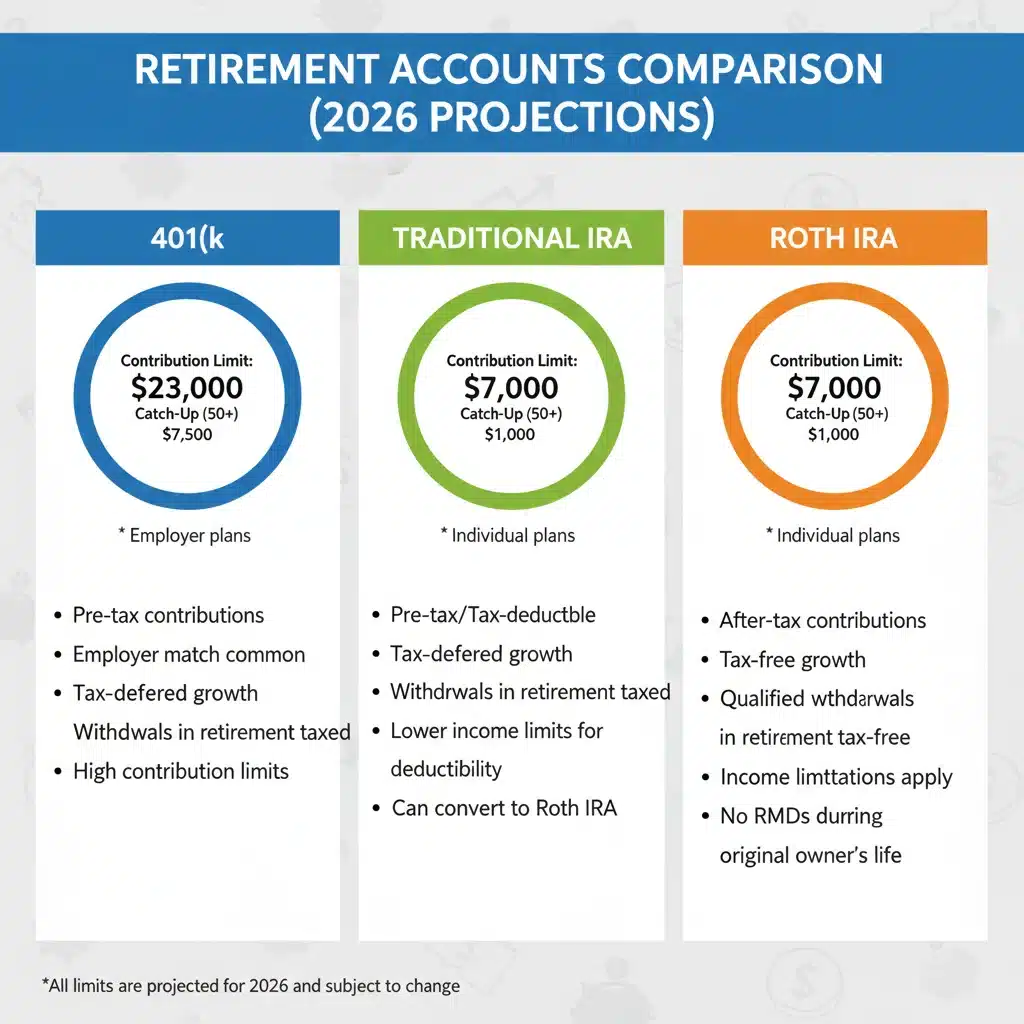
For instance, a 401(k) allows pre-tax contributions, reducing your current taxable income. The money grows tax-deferred until retirement. Roth IRAs, on the other hand, involve after-tax contributions, but qualified withdrawals in retirement are completely tax-free. Knowing the limits for each allows you to strategically allocate your savings to best suit your current income, tax bracket, and future financial goals.
Furthermore, employers often offer matching contributions to 401(k) plans. Failing to contribute enough to at least receive the full employer match is akin to leaving free money on the table. Understanding the limits ensures you’re maximizing this valuable benefit, which can significantly boost your retirement savings over time. Proactive planning based on projected limits for 2026 empowers you to make informed decisions and adjust your savings rate as needed to take full advantage of these opportunities.
Understanding How Contribution Limits Are Determined
The Internal Revenue Service (IRS) is responsible for setting and adjusting retirement contribution limits. These adjustments are primarily driven by inflation, as measured by the Consumer Price Index for All Urban Consumers (CPI-U). The IRS reviews these figures annually and typically announces the new limits in the late fall of the preceding year. While we won’t have the official 2026 numbers until late 2025, we can extrapolate based on historical inflation rates and current economic indicators.
The process involves a complex calculation. For example, 401(k) limits are often rounded to the nearest $500, while IRA limits are typically rounded to the nearest $50. These rounding conventions can sometimes lead to slight discrepancies in the expected increases based purely on inflation percentages. However, the core principle remains: as the cost of living increases, the IRS aims to adjust contribution limits to maintain the purchasing power of retirement savings.
Other factors, such as legislative changes, although less frequent, can also influence these limits. For instance, the SECURE Act and SECURE Act 2.0 introduced several changes to retirement plan rules, including adjustments to catch-up contributions and required minimum distribution (RMD) ages. While no major legislative changes are currently anticipated that would drastically alter the 2026 limits, it’s always wise to stay abreast of any new developments that could impact your retirement strategy.
Projected IRA Contribution Limits for 2026
Individual Retirement Arrangements (IRAs) are a cornerstone of personal retirement savings. They come in various forms, each with its own set of rules and benefits. For 2026, based on current inflation trends, we can anticipate an increase in the standard IRA contribution limits.
Traditional and Roth IRA Limits
For 2025, the standard IRA contribution limit is $7,000. Assuming a moderate inflation rate of around 3-4% between 2024 and 2025, and then similar for 2025-2026, it is reasonable to project the Retirement Contribution Limits 2026 for Traditional and Roth IRAs to be in the range of $7,500 to $8,000. This would represent an increase of $500 to $1,000 over the 2025 limit. Remember, these are projections, and the official numbers will be released by the IRS in late 2025.
IRA Catch-Up Contributions for 2026
For individuals aged 50 and over, the IRS allows additional "catch-up" contributions to IRAs. This provision is designed to help older workers boost their retirement savings as they approach retirement. For 2025, the IRA catch-up contribution limit is $1,000, which is not indexed for inflation. Therefore, it is highly probable that the IRA catch-up contribution limit for 2026 will remain at $1,000. This means individuals aged 50 and older could potentially contribute between $8,500 and $9,000 to their IRAs in 2026.
Income Limitations for Roth IRAs
It’s important to remember that Roth IRAs have income limitations. If your modified adjusted gross income (MAGI) exceeds certain thresholds, your ability to contribute directly to a Roth IRA may be phased out or eliminated entirely. These income thresholds are also adjusted annually for inflation. For 2026, we can expect these MAGI limits to also see an upward adjustment, allowing more individuals or those with higher incomes to contribute to Roth IRAs. Stay tuned for official IRS announcements regarding these specific thresholds.
Projected 401(k) and Other Employer-Sponsored Plan Limits for 2026
Employer-sponsored retirement plans, such as 401(k)s, 403(b)s, and the Thrift Savings Plan (TSP), represent the primary retirement savings vehicle for many Americans. These plans typically have higher contribution limits than IRAs, allowing for more substantial tax-advantaged savings.
401(k), 403(b), and TSP Limits
For 2025, the employee contribution limit for 401(k)s, 403(b)s, and the TSP is $23,000. Applying a similar inflation projection of 3-4% for 2025-2026, we can anticipate the Retirement Contribution Limits 2026 for these plans to increase to approximately $24,500 to $25,500. This potential increase of $1,500 to $2,500 provides a significant opportunity for employees to boost their retirement savings.
401(k) Catch-Up Contributions for 2026
Similar to IRAs, individuals aged 50 and older can make additional catch-up contributions to their 401(k)s, 403(b)s, and TSP accounts. For 2025, this catch-up limit is $7,500. Unlike IRA catch-up contributions, the 401(k) catch-up limit is indexed for inflation, though often in $500 increments. Therefore, for 2026, it is plausible to see this limit increase to $8,000, allowing older workers to contribute even more – potentially up to $32,500 to $33,500 in total (employee contribution + catch-up).
Overall 401(k) Contribution Limit (Employee + Employer)
There is also an overall limit to how much can be contributed to a 401(k) from all sources (employee contributions, employer matching contributions, and profit-sharing contributions). For 2025, this limit is $69,000. With inflation adjustments, this overall limit for 2026 could climb to approximately $72,000 to $75,000. This higher limit is particularly relevant for high-income earners and business owners who can maximize both their own contributions and employer contributions.
Other Retirement Plans and Their Projected 2026 Limits
Beyond traditional IRAs and 401(k)s, several other retirement savings vehicles cater to specific needs, especially for self-employed individuals and small business owners. Staying informed about their limits for 2026 is equally important.
SEP IRA Contribution Limits for 2026
Simplified Employee Pension (SEP) IRAs are popular among self-employed individuals and small business owners due to their ease of administration and high contribution limits. Contributions to a SEP IRA are made solely by the employer (which can be the individual themselves if self-employed) and are based on a percentage of compensation. For 2025, the maximum contribution to a SEP IRA is the lesser of $69,000 or 25% of the employee’s compensation. For 2026, we can expect this limit to increase, likely aligning with the overall 401(k) limit, potentially reaching $72,000 to $75,000.
SIMPLE IRA Contribution Limits for 2026
Savings Incentive Match Plan for Employees (SIMPLE) IRAs are another option for small businesses. They allow both employee and employer contributions. For 2025, the employee contribution limit for a SIMPLE IRA is $16,000. For 2026, a reasonable projection for the employee contribution limit, considering inflation, would be around $16,500 to $17,000. The catch-up contribution for those aged 50 and over, which is $3,500 for 2025, is also indexed for inflation and could see a slight increase to $4,000 in 2026.
Health Savings Account (HSA) Limits for 2026
While not strictly a retirement account, Health Savings Accounts (HSAs) are often referred to as "triple tax-advantaged" accounts and can serve as a powerful retirement savings tool, especially for healthcare expenses in retirement. Contributions are tax-deductible, growth is tax-free, and qualified withdrawals are tax-free. For 2025, the individual contribution limit for an HSA is $4,150, and the family limit is $8,300. We can anticipate these limits to increase for 2026, possibly reaching around $4,300 to $4,400 for individuals and $8,600 to $8,800 for families. The catch-up contribution for those aged 55 and over, which is $1,000, is not indexed for inflation and is expected to remain the same.
Strategies to Maximize Your Retirement Savings in 2026
Knowing the projected Retirement Contribution Limits 2026 is just the first step. The next is to develop a robust strategy to utilize these limits effectively. Here are several key strategies:
1. "Max Out" Your Employer-Sponsored Plan
If financially feasible, aim to contribute the maximum allowable amount to your 401(k), 403(b), or TSP. This is especially crucial if your employer offers a matching contribution. Contribute at least enough to get the full match – it’s essentially a 100% return on your investment, guaranteed. If you can, go beyond the match and contribute the full employee limit. The tax benefits and compounded growth over time are substantial.
2. Utilize Catch-Up Contributions
If you’re 50 or older by the end of 2026, take full advantage of the catch-up contribution provisions for both your IRAs and employer-sponsored plans. These additional contributions can make a significant difference in your retirement readiness, especially if you started saving later in life or had periods where you couldn’t contribute as much.
3. Diversify with an IRA (Traditional or Roth)
Even if you contribute to an employer-sponsored plan, consider opening and contributing to an IRA. A Traditional IRA may offer a tax deduction, while a Roth IRA offers tax-free withdrawals in retirement. The choice depends on your current income, expected future tax bracket, and eligibility. Contributing to both a 401(k) and an IRA allows you to diversify your tax treatment in retirement and potentially save more overall.
4. Consider a Backdoor Roth IRA
If your income exceeds the limits for direct Roth IRA contributions, don’t despair. The "backdoor Roth IRA" strategy allows high-income earners to contribute to a Roth IRA. This involves contributing non-deductible funds to a Traditional IRA and then converting them to a Roth IRA. While there are no income limits for conversions, it’s crucial to understand the pro-rata rule if you have existing pre-tax IRA balances. Consult a financial advisor to ensure you execute this strategy correctly.
5. Explore HSAs as a Retirement Savings Vehicle
If you’re enrolled in a high-deductible health plan (HDHP), an HSA can be an incredibly powerful tool for retirement. Maximize your contributions to your HSA. The triple tax advantage (tax-deductible contributions, tax-free growth, tax-free withdrawals for qualified medical expenses) makes it an excellent complement to traditional retirement accounts. You can invest HSA funds, and any unused balance rolls over year after year, effectively becoming an additional retirement savings account that can be used for healthcare costs in retirement, which often increase significantly.
6. Automate Your Savings
Set up automatic contributions to your retirement accounts. This "pay yourself first" approach ensures consistency and helps you stick to your savings goals. Even small, regular contributions add up significantly over time due to the power of compounding.
7. Review and Adjust Annually
Your financial situation, career, and retirement goals can change. Make it a habit to review your retirement plan annually. Check your contribution rates, investment allocations, and ensure you’re on track to meet your goals. Adjust your contributions to reflect the new Retirement Contribution Limits 2026 as soon as they are officially announced.

The Impact of Inflation on Your Retirement Savings
Inflation is a silent thief of purchasing power, and its effects on long-term retirement savings cannot be underestimated. The annual adjustments to Retirement Contribution Limits 2026 are a direct response to inflation. However, it’s not just the limits that are impacted; the value of your savings in retirement is also at stake.
A dollar saved today will likely have less purchasing power in 20, 30, or 40 years due to inflation. This is why it’s crucial to invest your retirement savings in assets that have the potential to outpace inflation. Historically, equities (stocks) have provided better long-term returns than inflation, while fixed-income investments (bonds) may offer more stability but lower growth potential.
When planning for retirement, always factor in inflation. If you project needing $100,000 per year in today’s dollars to maintain your lifestyle in retirement, you’ll need significantly more in future dollars. For example, with an average inflation rate of 3%, $100,000 today would require approximately $180,611 in 20 years to maintain the same purchasing power. Therefore, maximizing your contributions to take advantage of tax-advantaged growth and investing wisely are your best defenses against the eroding effects of inflation.
When Will the Official 2026 Limits Be Announced?
While we’ve provided informed projections for the Retirement Contribution Limits 2026, it’s important to remember that these are not official figures. The Internal Revenue Service (IRS) typically announces the official retirement plan contribution limits for the upcoming year in the late fall of the preceding year. This means we can expect the official 2026 limits to be released sometime in October or November of 2025.
It is always advisable to consult the official IRS publications or a qualified financial advisor for the most accurate and up-to-date information once these announcements are made. Financial institutions and news outlets will also widely report on the new limits as soon as they are released.
Conclusion: Proactive Planning for a Secure Retirement
Navigating the world of retirement planning requires diligence, foresight, and a commitment to staying informed. The projected Retirement Contribution Limits 2026 offer a valuable glimpse into the future, allowing you to fine-tune your savings strategy and ensure you’re on the right path to financial independence.
By understanding how these limits are determined, anticipating potential increases, and implementing smart savings strategies, you can maximize your tax-advantaged contributions to your 401(k)s, IRAs, and other retirement vehicles. Remember the power of compounding, the importance of employer matches, and the protective shield against inflation that smart investing provides.
Don’t wait for the official announcements in late 2025 to start planning. Use these projections as a catalyst to review your current savings, consider increasing your contributions, and consult with a financial advisor to tailor a plan that aligns with your unique financial goals and circumstances. Your future self will thank you for the proactive steps you take today to secure a comfortable and fulfilling retirement.