Understanding the future of your Social Security benefits is not just a matter of curiosity; it’s a critical component of sound retirement planning. As we look towards 2026, several factors are converging that could significantly shape the landscape of 2026 Social Security benefits. For future retirees, staying informed about these potential changes is paramount to making well-informed financial decisions.
Anúncios
The Evolving Landscape of 2026 Social Security Benefits
Social Security has been a cornerstone of American retirement for decades, providing a vital safety net for millions. However, the system is not static. It’s continually influenced by economic shifts, demographic trends, and legislative considerations. The year 2026 is particularly significant as it approaches the midpoint of the next decade, bringing into sharper focus long-term projections and potential adjustments. These adjustments can impact everything from the monthly benefit amount you receive to the age at which you can claim full benefits.
Why 2026 Matters for Future Retirees
For those planning to retire in or around 2026, understanding the specific projections and potential policy shifts is crucial. The decisions made today, or even in the next few years, can have a lasting impact on your financial well-being throughout retirement. This article will delve into the key areas of 2026 Social Security benefits, including the Cost-of-Living Adjustment (COLA), eligibility requirements, taxation, and strategic planning tips.
Anúncios
Cost-of-Living Adjustment (COLA) for 2026 Social Security Benefits
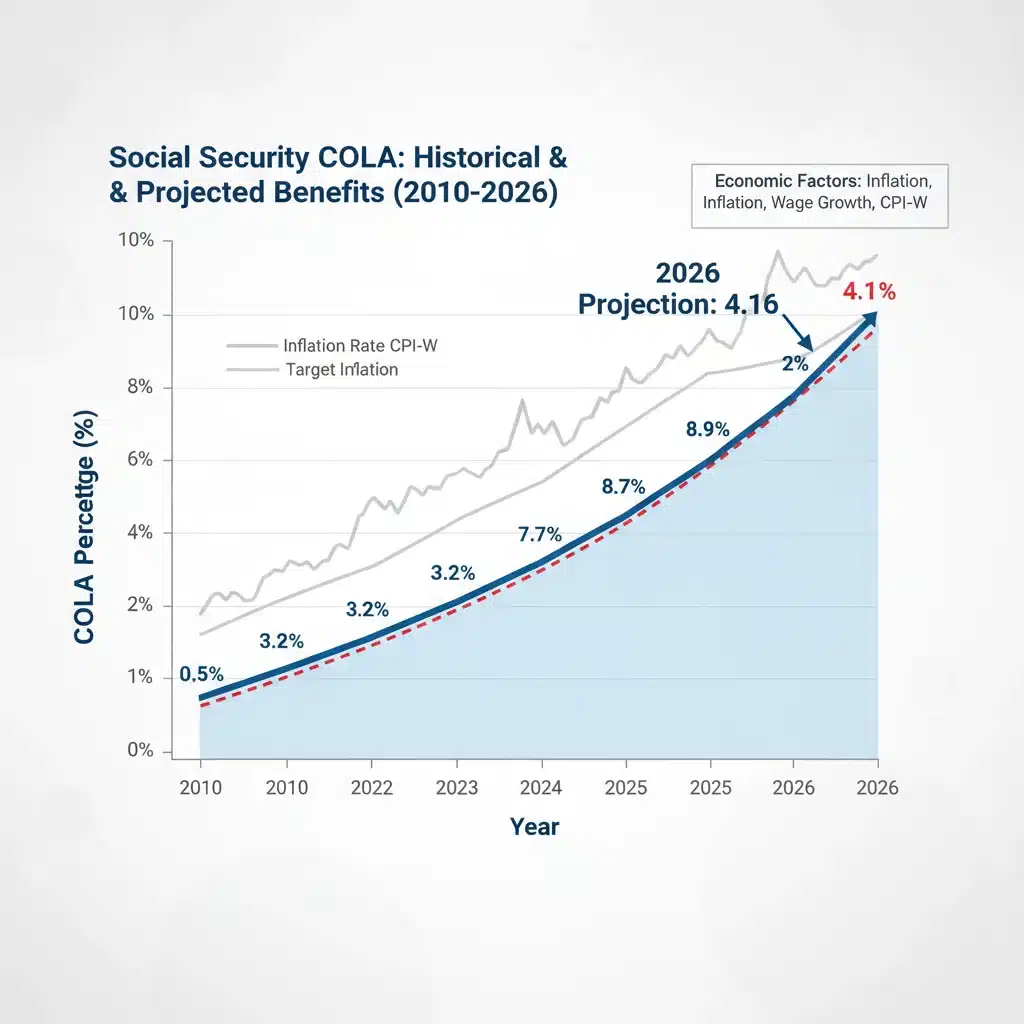
One of the most anticipated aspects of Social Security is the annual Cost-of-Living Adjustment (COLA). COLA is designed to ensure that the purchasing power of Social Security benefits is not eroded by inflation. It’s based on the Consumer Price Index for Urban Wage Earners and Clerical Workers (CPI-W) and is typically announced in October of the preceding year. While we won’t have the official 2026 COLA until late 2025, we can explore the factors that influence it and what current projections suggest.
How COLA is Calculated
The COLA calculation involves comparing the average CPI-W for the third quarter (July, August, and September) of the current year with the average for the same period of the last year in which a COLA was payable. The percentage increase, if any, is the COLA. If there’s no increase, there’s no COLA for that year.
Projections and Economic Factors Affecting 2026 COLA
Forecasting the 2026 COLA requires an understanding of economic trends. Inflationary pressures, wage growth, and global economic stability all play a role. Current economic indicators and expert analyses can offer insights, though these are always subject to change. Higher inflation generally leads to a higher COLA, while periods of low inflation or deflation can result in minimal or no COLA. For those relying on 2026 Social Security benefits, these projections are a critical piece of the puzzle.
Economic forecasts for the mid-2020s are varied. Some economists predict a return to more moderate inflation rates, while others foresee persistent price pressures due to factors like supply chain disruptions, geopolitical events, and evolving labor markets. These differing views highlight the uncertainty inherent in COLA predictions. However, tracking official government reports and reputable economic analyses can help individuals gauge potential adjustments to their 2026 Social Security benefits.
Eligibility and Full Retirement Age (FRA) for 2026
The age at which you can claim full Social Security benefits, known as the Full Retirement Age (FRA), is a crucial determinant of your monthly payment. For individuals born in 1960 or later, the FRA is 67. This means that if you were born in 1960, your FRA will be reached in 2027. For those born in 1959, your FRA is 66 and 10 months, meaning you would reach it in late 2025 or early 2026, depending on your birth month.
Understanding Your Full Retirement Age
If you claim benefits before your FRA, your monthly payment will be permanently reduced. Conversely, if you delay claiming benefits past your FRA (up to age 70), you can earn delayed retirement credits, which will increase your monthly payment. For someone considering claiming 2026 Social Security benefits, understanding their specific FRA is paramount.
Potential Changes to FRA and Eligibility Rules
While the current FRA schedule is set, there are ongoing discussions and proposals to adjust the FRA for future generations. These discussions are often driven by concerns about the long-term solvency of the Social Security trust funds. While it’s unlikely that the FRA for those retiring in 2026 will change dramatically, it’s important for younger workers to be aware that future legislative actions could impact their own retirement age. Any significant changes to eligibility criteria or the FRA would likely be phased in over many years, providing ample notice. Nonetheless, keeping an eye on legislative developments is a prudent strategy for anyone planning their retirement.
Earning Credits for 2026 Social Security Benefits
To qualify for Social Security benefits, you need to earn work credits. In 2024, you earn one credit for every $1,730 in earnings, up to a maximum of four credits per year. Most people need 40 credits (10 years of work) to be eligible for retirement benefits. These credit requirements are subject to annual adjustments based on national average wage index. For those approaching retirement and planning for 2026 Social Security benefits, ensuring you have the necessary credits is a fundamental step.
Taxation of Social Security Benefits in 2026
One aspect that often surprises retirees is that Social Security benefits can be taxable. The extent to which your benefits are taxed depends on your “combined income,” which includes your adjusted gross income, tax-exempt interest, and half of your Social Security benefits.
Current Taxation Rules
Under current law, up to 50% of your Social Security benefits may be taxable if your combined income is between $25,000 and $34,000 for an individual, or between $32,000 and $44,000 for a married couple filing jointly. If your combined income exceeds these thresholds, up to 85% of your benefits may be taxable.
Potential Legislative Changes and Their Impact on 2026 Social Security Benefits
There are ongoing debates about adjusting these income thresholds or changing the taxation formula for Social Security benefits. Proposals often aim to increase revenue for the Social Security trust funds or to make the system more progressive. While no specific changes have been enacted for 2026, it’s a topic that frequently arises in discussions about Social Security reform. Any alteration could significantly impact the net amount of 2026 Social Security benefits you receive.
For future retirees, this means that tax planning should be an integral part of their overall retirement strategy. Understanding how your other sources of retirement income (pensions, 401(k)s, IRAs, investments) interact with your Social Security benefits can help you minimize your tax liability. Consulting with a financial advisor specializing in retirement tax planning can provide invaluable guidance in this complex area.
The Solvency Challenge and Future Reforms
The long-term solvency of the Social Security system is a recurring concern. The annual Trustees’ Report provides projections on the financial health of the trust funds. While the system is expected to be able to pay full benefits for several more years, projections indicate that without legislative action, the trust funds may only be able to pay a percentage of promised benefits in the future.
Understanding the Social Security Trust Funds
The Social Security system operates on a pay-as-you-go basis, with current workers’ contributions funding current retirees’ benefits. The trust funds act as a reserve. Demographic shifts, such as lower birth rates, increased life expectancy, and the retirement of the large baby boomer generation, are putting pressure on this system.
Proposed Reforms and Their Implications for 2026 Social Security Benefits
Various proposals have been put forth to address the solvency challenge. These include:
- Increasing the Full Retirement Age: As mentioned earlier, this is a frequently discussed option.
- Adjusting the COLA Formula: Changing how the COLA is calculated, perhaps to a less generous measure, could save money.
- Raising the Payroll Tax Cap: Currently, only earnings up to a certain amount are subject to Social Security taxes. Raising or eliminating this cap would increase revenue.
- Increasing the Payroll Tax Rate: A small increase in the percentage of earnings contributed to Social Security could also bolster the trust funds.
- Means-Testing Benefits: This would involve reducing benefits for higher-income retirees.
While it’s unlikely that major, sweeping reforms would be implemented and affect 2026 Social Security benefits in a drastic way without significant lead time, the ongoing discussion underscores the importance of not solely relying on Social Security for your retirement income. These conversations shape the political and economic environment that will ultimately determine the long-term outlook for benefits.
Strategic Planning for Maximizing Your 2026 Social Security Benefits
Given the complexities and potential changes, strategic planning is essential. Here are some key considerations for those approaching retirement in or around 2026:
1. Understand Your Benefit Statement
Regularly review your Social Security statement, which you can access online through your My Social Security account. This statement provides an estimate of your future benefits based on your earnings record. Ensure your earnings record is accurate, as errors can impact your future benefits.
2. Optimize Your Claiming Age
Deciding when to claim your benefits is one of the most significant decisions you’ll make. Claiming early (as early as age 62) results in reduced monthly payments but more years of receiving benefits. Delaying until your FRA or even age 70 results in higher monthly payments. The optimal claiming age depends on various factors, including your health, other retirement income sources, and life expectancy.
- Early Claiming: If you need the income, have health issues, or don’t expect to live a long life, claiming early might make sense. However, be aware of the permanent reduction in benefits.
- Full Retirement Age Claiming: This is the age at which you receive 100% of your earned benefits. It’s a common choice for many retirees.
- Delayed Claiming: For each year you delay past your FRA, up to age 70, your benefit increases by approximately 8% per year. This can be a powerful way to maximize your monthly income, especially if you have other resources to cover expenses in your early retirement years.
3. Coordinate with Spousal Benefits
If you are married, divorced, or widowed, there are specific rules regarding spousal and survivor benefits that can significantly increase your household’s total Social Security income. Understanding these rules and coordinating claiming strategies with your spouse is vital. For example, one spouse might claim early while the other delays to maximize their own benefit, then switches to a higher spousal benefit later.
4. Consider Other Retirement Income Sources
Social Security is designed to replace only a portion of your pre-retirement income. It’s crucial to have other retirement savings, such as 401(k)s, IRAs, pensions, and personal investments. Diversifying your income sources provides greater financial security and flexibility, especially if there are unexpected changes to 2026 Social Security benefits.
5. Stay Informed About Legislative Developments
As discussed, the Social Security system is subject to ongoing legislative review. Staying informed about proposed reforms and potential changes can help you adjust your retirement plan proactively. Follow reputable financial news sources and the official Social Security Administration website for updates.
6. Consult a Financial Advisor
A qualified financial advisor specializing in retirement planning can help you navigate the complexities of Social Security, integrate it into your overall financial plan, and make informed decisions about claiming strategies, tax implications, and investment allocation. They can provide personalized advice tailored to your unique circumstances and goals for your 2026 Social Security benefits and beyond.

The Impact of Economic Conditions on 2026 Social Security Benefits
Beyond COLA, broader economic conditions can indirectly influence your 2026 Social Security benefits. For instance, a robust economy with low unemployment and strong wage growth can contribute to the solvency of the Social Security trust funds by increasing payroll tax contributions. Conversely, economic downturns can strain the system.
Inflation and Purchasing Power
Even with COLA, persistent high inflation can still erode the purchasing power of your benefits if the COLA doesn’t fully keep pace with your personal cost of living. Retirees often face specific inflation rates for healthcare and other essential services that may differ from the broader CPI-W used for COLA calculations. This makes having diversified retirement income streams even more important.
Interest Rates and Trust Fund Investments
The Social Security trust funds invest in special issue U.S. Treasury securities. Interest rates can affect the returns on these investments, which in turn impacts the financial health of the trust funds. While not a direct factor in your individual benefit calculation, the overall economic environment, including interest rate trends, plays a role in the long-term stability of the system that pays your 2026 Social Security benefits.
Special Considerations: Disability and Survivor Benefits
While much of the focus is on retirement benefits, it’s important to remember that Social Security also provides crucial disability and survivor benefits. These benefits operate under similar principles regarding eligibility and taxation but have their own specific rules.
Disability Benefits
If you become disabled and unable to work, Social Security Disability Insurance (SSDI) can provide a vital income stream. Eligibility depends on your work history and the severity of your condition. The amount of your disability benefit is based on your average lifetime earnings. For those who might need to claim disability benefits in or around 2026, understanding the application process and medical criteria is essential.
Survivor Benefits
Social Security also provides benefits to surviving family members of a deceased worker, including spouses, children, and dependent parents. The amount of survivor benefits depends on the deceased worker’s earnings record and the relationship of the survivor. These benefits can be a crucial financial lifeline for families experiencing loss. Understanding these provisions is part of comprehensive financial planning, even for those primarily focused on their own 2026 Social Security benefits.
The Importance of Early Planning
The overarching message for anyone concerned about 2026 Social Security benefits, or indeed any future retirement benefits, is the critical importance of early and consistent planning. The earlier you start, the more options you have and the greater your ability to adapt to potential changes.
Building a Robust Retirement Portfolio
Relying solely on Social Security is rarely sufficient for a comfortable retirement. Building a diversified retirement portfolio that includes employer-sponsored plans (like 401(k)s), individual retirement accounts (IRAs), and other investments is fundamental. These additional savings provide a buffer against any unexpected reductions in Social Security benefits or higher-than-anticipated living costs.
Educate Yourself Continuously
The world of retirement planning is dynamic. Laws change, economic conditions shift, and personal circumstances evolve. Make it a habit to regularly educate yourself about Social Security, tax laws, and investment strategies. Resources like the Social Security Administration’s website, reputable financial publications, and professional advisors are invaluable.
Review and Adjust Your Plan
Your retirement plan shouldn’t be a one-time creation. It should be a living document that you review and adjust periodically, especially as you get closer to retirement. As 2026 approaches, it becomes even more important to fine-tune your strategy based on the latest information regarding 2026 Social Security benefits, economic forecasts, and your personal financial situation.
Conclusion: Navigating Your Future with Confidence
While predicting the exact nature of 2026 Social Security benefits can be challenging, a proactive and informed approach can empower future retirees to navigate the landscape with confidence. By understanding the factors influencing COLA, eligibility, and taxation, and by engaging in strategic planning, you can optimize your Social Security benefits and integrate them effectively into a robust overall retirement plan.
Remember, Social Security is a vital component of retirement security, but it’s just one piece of the puzzle. Combining a solid understanding of its workings with diligent personal savings and professional financial advice will put you in the best possible position to enjoy a secure and fulfilling retirement, regardless of the specific changes that 2026 may bring.
Start your planning today, stay informed, and take control of your financial future. Your peace of mind in retirement is worth the effort.