AI in American Music: 2026 Innovations & Future Trends
Anúncios
The Impact of AI on American Music Composition: Recent Developments in 2026
The year is 2026, and the landscape of American music composition has undergone a profound metamorphosis, largely driven by the relentless march of Artificial Intelligence. What was once the exclusive domain of human intuition and learned skill is now a vibrant, collaborative space where algorithms and artists intertwine. The impact of AI music composition is not merely a technological novelty; it’s a fundamental shift in how music is conceived, produced, and consumed across the United States. From Nashville’s country anthems to Brooklyn’s indie beats, AI is leaving an indelible mark, offering new tools, pushing creative boundaries, and challenging traditional notions of artistry.
Anúncios
For decades, the idea of machines composing music was relegated to science fiction. Today, it’s a tangible reality, with sophisticated AI models capable of generating everything from classical symphonies to contemporary pop tracks. These aren’t just random sequences of notes; they are compositions imbued with stylistic nuances, emotional depth, and structural integrity that often rival human-made works. The core of this revolution lies in machine learning, particularly deep learning, which allows AI to analyze vast datasets of existing music, identify patterns, and then create original pieces based on those learned styles.
In 2026, the discussion around AI music composition has moved beyond mere curiosity to practical application. Major record labels are investing heavily in AI research and development, independent artists are leveraging AI tools to overcome creative blocks, and academic institutions are exploring the theoretical and ethical implications of this new frontier. This article delves into the recent developments, key players, and future trajectories of AI’s influence on American music composition, providing a comprehensive overview of this exciting and sometimes controversial evolution.
Anúncios
The Evolution of AI in Music: A Brief Retrospective to 2026
To truly appreciate the current state of AI music composition, it’s essential to understand its journey. Early attempts at algorithmic composition in the mid-20th century were often rule-based, producing music that was technically correct but lacked soul. These systems followed explicit instructions, much like a chef following a recipe step-by-step. While groundbreaking for their time, they couldn’t capture the inherent unpredictability and emotional resonance that defines great music.
The real breakthrough came with the advent of machine learning, particularly neural networks, in the late 2000s and early 2010s. Researchers began feeding AI vast libraries of music, allowing it to learn the underlying structures, harmonies, melodies, and rhythms without explicit programming. Projects like Google’s Magenta and Jukebox by OpenAI demonstrated AI’s ability to generate coherent and stylistically diverse musical pieces. These early iterations were impressive but often required significant human curation and refinement.
By 2020, AI tools started becoming more accessible to mainstream artists, offering features like automatic chord progression generation, melody suggestions, and even full song generation. The COVID-19 pandemic, ironically, accelerated this adoption as musicians sought new ways to create and collaborate remotely. This period saw a significant rise in AI-powered plugins and standalone applications designed to assist human composers rather than replace them.
Fast forward to 2026, and the sophistication of AI music composition has reached unprecedented levels. Generative Adversarial Networks (GANs) and Transformer models are now capable of producing highly nuanced and emotionally resonant music. These models can learn from diverse musical genres simultaneously, allowing for the creation of innovative hybrid styles. Furthermore, AI is increasingly being used for real-time composition, adapting to live performances and audience reactions, creating truly dynamic musical experiences.
The focus has shifted from simply generating notes to understanding musical context, emotion, and even intention. AI systems can now analyze lyrical content and compose accompanying music that enhances the narrative. They can adapt to specific instrumentation, create variations on existing themes, and even mimic the unique compositional styles of famous artists. This rapid evolution has made AI an indispensable part of many American music studios and creative processes.
Current Landscape of AI Music Composition in America (2026)
In 2026, the American music scene is a melting pot of human and artificial intelligence. From Hollywood film scores to independent SoundCloud releases, AI’s fingerprints are everywhere. Here are some of the key areas where AI music composition is making a significant impact:
1. Generative AI for Creative Inspiration
One of the most widespread applications of AI is as a creative partner. Composers and songwriters are using AI tools to overcome writer’s block, generate fresh ideas, and explore unexpected musical directions. Platforms like Amper Music, AIVA, and Jukebox (now with vastly improved interfaces and capabilities) allow users to input parameters such as genre, mood, instrumentation, and desired length, and the AI generates complete musical pieces or sections. Artists can then take these AI-generated foundations and build upon them, adding their unique human touch.
For instance, a pop songwriter struggling with a chorus melody might feed their lyrical ideas into an AI, which then suggests several melodic variations. A film composer might use AI to quickly generate atmospheric background scores or thematic motifs, freeing up time to focus on the more intricate emotional core of the soundtrack. This symbiotic relationship between human and machine is fostering a new era of artistic exploration.
2. Personalization and Adaptive Music
AI is revolutionizing how music is consumed, particularly through personalization. Streaming services are employing advanced AI algorithms not just to recommend music, but to adapt it. Imagine a workout playlist where the tempo and intensity of the music dynamically adjust to your heart rate, or a video game soundtrack that subtly changes based on player actions and narrative progression. This adaptive music, often composed or remixed by AI in real-time, creates deeply immersive and personalized experiences.
In 2026, several startups in the US are specializing in adaptive music for various applications, from fitness apps to therapeutic soundscapes. This niche of AI music composition is growing rapidly, promising a future where music is not just listened to, but actively experienced and shaped by the individual.
3. AI-Assisted Production and Mastering
Beyond composition, AI is also streamlining the production and mastering processes. AI-powered mixing tools can analyze individual tracks, identify common issues, and suggest optimal EQ, compression, and reverb settings. AI mastering algorithms can achieve professional-grade sound quality, often at a fraction of the cost and time traditionally required by human engineers. While many purists still prefer human ears for the final polish, AI provides an invaluable assistant, especially for independent artists with limited budgets.
These tools are democratizing music production, allowing more artists to achieve a polished sound without needing extensive technical expertise or expensive studio time. The accessibility of high-quality production is a significant development, fueled by advancements in AI music composition and audio processing.
4. Ethical and Legal Considerations: Copyright and Authorship
The rise of AI music composition has inevitably brought forth complex ethical and legal questions, particularly concerning copyright and authorship. Who owns the copyright to a piece of music composed by an AI? Is it the developer of the AI, the user who inputs the parameters, or the AI itself (a concept currently not recognized by law)? In 2026, these questions are at the forefront of legal debates within the American music industry.
The U.S. Copyright Office is grappling with these issues, attempting to formulate guidelines that balance innovation with the protection of human creators. There’s a growing consensus that for a work to be copyrighted, there must be a human author. However, the degree of human intervention required for AI-generated music to qualify for copyright protection remains a contentious point. This ongoing debate is shaping how artists and tech companies approach the creation and monetization of AI-assisted music.

Case Studies: AI in Action in American Music (2026)
To illustrate the tangible impact of AI music composition, let’s look at some notable examples from 2026:
The ‘Synthwave Symphony’ Project
A collaborative project between a major American symphony orchestra and an AI development lab resulted in the ‘Synthwave Symphony.’ The AI analyzed thousands of synthwave tracks from the 1980s, classical symphonies, and contemporary electronic music. Its task was to compose a five-movement symphony that blended the nostalgic aesthetics of synthwave with the grandeur of orchestral music. Human composers then orchestrated the AI’s core ideas, refined melodies, and added expressive dynamics.
The resulting performances were critically acclaimed, demonstrating how AI could serve as a powerful catalyst for genre fusion and innovative artistic expression. This project highlighted the strength of human-AI collaboration, where the AI provided novel structural and melodic frameworks, and human ingenuity infused them with emotional depth and instrumental color.
Independent Artist ‘Aetheria’ and AI Songwriting
Aetheria, an emerging indie-pop artist based in Los Angeles, has gained significant traction for her unique sound, which she openly attributes to her use of AI music composition tools. She leverages an AI platform that can generate lyrical themes, chord progressions, and even vocal harmonies based on her initial musical sketches and mood descriptions.
“It’s like having an incredibly talented co-writer who never gets tired and always has fresh ideas,” Aetheria states in a recent interview. “I give it a starting point – a feeling, a phrase, a simple melody – and it gives me dozens of variations to work with. It doesn’t replace my creativity; it amplifies it.” Her success story is becoming increasingly common among independent artists who find AI tools to be an equalizer, allowing them to produce high-quality music without extensive resources.
AI in Film Scoring: ‘Echoes of Tomorrow’
The blockbuster sci-fi film ‘Echoes of Tomorrow,’ released in early 2026, featured a groundbreaking score where approximately 40% of the music was composed by AI. The film’s lead composer, a veteran in Hollywood, utilized AI to generate intricate atmospheric soundscapes, tension-building cues, and even some character leitmotifs. The AI was trained on a vast library of science fiction film scores, allowing it to understand the conventions and emotional impact of the genre.
This allowed the human composer to focus on the most critical emotional beats and character arcs, leaving the more repetitive or technically complex generative tasks to the AI. The result was a seamless blend of human artistry and algorithmic precision, contributing to the film’s immersive experience and setting a new precedent for AI’s role in cinematic music.
Challenges and Criticisms of AI Music Composition
Despite its remarkable advancements, AI music composition is not without its challenges and criticisms.
The ‘Soul’ Argument
Perhaps the most common critique is the argument that AI-generated music lacks ‘soul’ or genuine emotion. Critics contend that while AI can mimic human emotional expression, it doesn’t truly understand or feel emotions. Therefore, its compositions, no matter how technically perfect, will always be sterile or hollow. This philosophical debate continues to rage in artistic circles, with proponents of AI arguing that the emotional impact of music is ultimately in the ear of the listener, regardless of its origin.
Job Displacement Concerns
As AI tools become more sophisticated, concerns about job displacement within the music industry are growing. Will AI replace human composers, session musicians, and producers? While many believe AI will augment human roles rather than replace them, the fear of automation taking over creative jobs is a valid one, particularly for those in entry-level positions or those performing highly standardized musical tasks.
Homogenization of Music
Another concern is the potential for AI to lead to a homogenization of music. If AI models are primarily trained on existing popular music, there’s a risk that they might perpetuate existing trends and styles, leading to a lack of true innovation. While advanced AI can generate novel combinations, the underlying algorithms are still influenced by their training data. This raises questions about whether AI will truly push artistic boundaries or merely optimize existing formulas for commercial success.
Ethical Use and Bias
Like all AI systems, musical AI can inherit biases present in its training data. If an AI is predominantly trained on music from a specific cultural background or demographic, it might struggle to generate authentic music in other styles or even inadvertently perpetuate cultural stereotypes. Ensuring diverse and ethically sourced training data is crucial to developing fair and inclusive AI music composition tools.
The Future of AI and American Music Composition Beyond 2026
Looking beyond 2026, the trajectory of AI music composition in America appears to be one of continued integration and innovation. Several key trends are expected to shape its future:
Hyper-Personalized Music Experiences
Expect even deeper levels of personalization. AI will not only adapt music to your mood or activity but potentially compose entirely new pieces on demand, tailored to your specific taste profile, listening history, and even biometric data. Imagine an AI learning your preferred harmonic progressions, rhythmic patterns, and instrumental textures, then generating a unique soundtrack for your daily life.
Enhanced Human-AI Co-Creativity
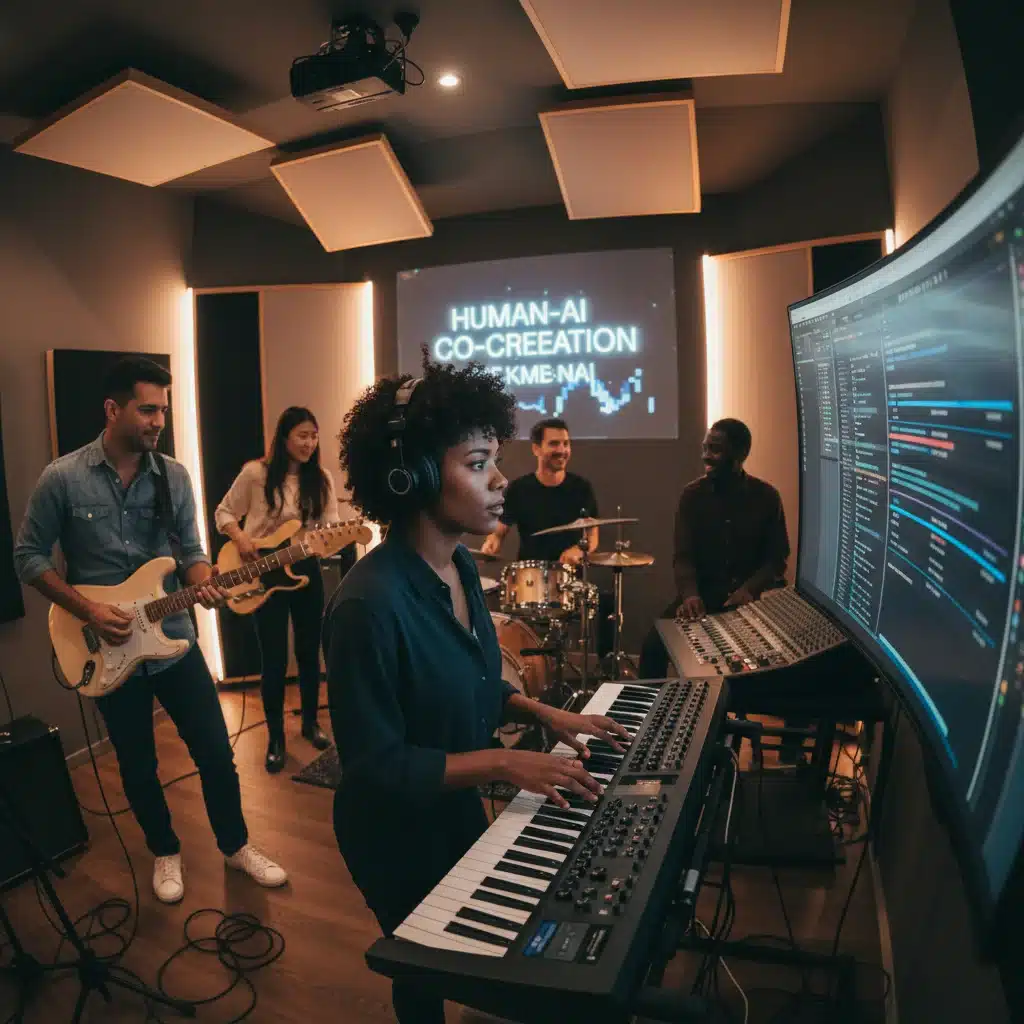
The synergy between human and AI will only grow stronger. AI will evolve from a tool to a more intuitive and responsive creative partner, capable of engaging in sophisticated musical dialogues with human composers. This could involve AI understanding nuanced artistic intentions, offering proactive suggestions, and even challenging human composers with unexpected musical solutions, fostering truly collaborative artistic relationships.
AI as a Preservation and Revitalization Tool
AI could play a significant role in preserving and revitalizing endangered musical traditions. By analyzing historical recordings and ethnographic data, AI could learn the intricacies of forgotten musical styles, allowing for their digital reconstruction, adaptation, and even the creation of new works in those traditions, ensuring cultural heritage is not lost.
New Forms of Musical Expression
The boundaries of what constitutes ‘music’ will continue to expand. AI is already exploring areas like generative sound art, interactive installations, and algorithmic improvisation. Future developments could lead to entirely new forms of musical expression that are impossible for humans to create alone, pushing the very definition of AI music composition into uncharted territories.
Education and Accessibility
AI tools will become even more integrated into music education, helping aspiring composers learn theory, practice improvisation, and experiment with different styles. This increased accessibility will democratize music creation further, allowing more individuals to explore their musical potential regardless of their formal training or access to expensive instruments.
Conclusion
The impact of AI music composition on American music in 2026 is undeniable and transformative. It has moved beyond a theoretical concept to become a practical, powerful force reshaping how music is created, produced, and experienced. While it presents exciting opportunities for innovation, efficiency, and personalization, it also raises important questions about authorship, creativity, and the future of human artists.
As we navigate this evolving landscape, it’s clear that AI is not an existential threat to human creativity but rather a potent new instrument in the composer’s toolkit. The most compelling music of the future will likely emerge from the harmonious collaboration between human ingenuity and artificial intelligence, pushing the boundaries of what’s possible and enriching the vibrant tapestry of American music for generations to come. The conversation surrounding AI in music is far from over; indeed, it’s just hitting its stride, promising a future filled with unprecedented sounds and artistic explorations.