Emergency Fund Building: Achieve 6 Months of Living Expenses Saved by December 2026

Anúncios
In an unpredictable world, financial security isn’t just a luxury; it’s a necessity. The foundation of this security for many is a robust emergency fund. Imagine facing an unexpected job loss, a medical emergency, or a sudden home repair without the crushing weight of financial panic. That’s the power of a well-stocked emergency fund. Our ambitious yet entirely achievable Emergency Fund Goal is to help you save six months of living expenses by December 2026. This isn’t just about stashing away cash; it’s about building peace of mind, resilience, and a stronger financial future.
Anúncios
Many financial experts recommend having at least three to six months’ worth of essential living expenses saved in an easily accessible account. For some, even more might be appropriate depending on job security, health, and family obligations. Our target of six months provides a comfortable buffer, offering significant protection against life’s curveballs. This comprehensive guide will walk you through the process, from understanding your current financial situation to implementing effective saving strategies and staying motivated on your journey to achieving your Emergency Fund Goal.
Why an Emergency Fund is Non-Negotiable
Before we dive into the ‘how,’ let’s reinforce the ‘why.’ An emergency fund acts as a financial safety net, preventing you from going into debt when unexpected costs arise. Without one, a minor setback can quickly snowball into a major financial crisis. Credit cards become a tempting, but ultimately expensive, solution. Loans can add further stress with interest payments. An emergency fund allows you to navigate these challenges calmly, without compromising your long-term financial goals or accruing high-interest debt.
Anúncios
Consider these common scenarios where an emergency fund proves invaluable:
- Job Loss or Income Reduction: This is arguably the most critical reason. Having six months of expenses means you have half a year to find new employment without immediate financial pressure, allowing you to make informed decisions rather than desperate ones.
- Medical Emergencies: Even with insurance, deductibles, co-pays, and uncovered services can quickly add up. An emergency fund ensures you can focus on recovery, not medical bills.
- Car Repairs: A sudden transmission failure or a blown tire can cost hundreds, if not thousands. Your emergency fund covers these without disrupting your monthly budget.
- Home Repairs: A leaky roof, a broken furnace, or a burst pipe can be incredibly costly. An emergency fund protects your largest asset.
- Unexpected Travel: Family emergencies or unforeseen events might require immediate travel, which can be expensive.
- Pet Emergencies: Veterinary bills for sick or injured pets can be substantial.
Without an emergency fund, these situations often lead to: taking out high-interest loans, racking up credit card debt, dipping into retirement savings (incurring penalties and taxes), or selling assets at a loss. None of these are desirable outcomes. Achieving your Emergency Fund Goal liberates you from these worries.
Step 1: Calculate Your Target Emergency Fund Goal
The first concrete step towards achieving your Emergency Fund Goal is to determine precisely how much you need to save. This isn’t a guesswork exercise; it requires a detailed understanding of your monthly living expenses. Grab a pen and paper, or open a spreadsheet, and list out all your essential monthly expenditures. Be thorough and honest.
What Counts as an Essential Living Expense?
When calculating your emergency fund target, focus on the absolute necessities – the expenses you cannot avoid. This typically includes:
- Housing: Rent or mortgage payments, property taxes, homeowner’s insurance.
- Utilities: Electricity, gas, water, internet (often essential for job searching).
- Food: Groceries for basic meals (not dining out or expensive takeout).
- Transportation: Car payments, insurance, gas, public transport costs.
- Insurance: Health, life, disability.
- Minimum Debt Payments: Student loan minimums, credit card minimums (though ideally, you’d be paying more, in an emergency, the minimum is key).
- Essential Personal Care: Basic toiletries, necessary medications.
What generally doesn’t count for the emergency fund calculation (though you might still spend on them): entertainment, dining out, subscriptions for streaming services, gym memberships, new clothes (unless essential for work), vacations, and luxury items. These are expenses you would cut immediately in a financial crisis.
The Calculation:
Add up all your essential monthly expenses. Let’s say this total comes to $3,000. Your six-month Emergency Fund Goal would then be $3,000 x 6 = $18,000.
This number might seem daunting at first, especially if you’re starting from scratch. However, breaking it down into smaller, manageable chunks over the next three years (until December 2026) makes it much more achievable. From now until December 2026, you have approximately 36 months. If your goal is $18,000, that’s $18,000 / 36 months = $500 per month. This is a clear, actionable target.
Step 2: Assess Your Current Financial Situation (The Budget Deep Dive)
Now that you know your target, the next crucial step is to understand where your money is currently going. This involves creating a detailed budget, if you don’t already have one. A budget is not about restriction; it’s about control and awareness. It’s your roadmap to achieving your Emergency Fund Goal.
Track Your Spending:
For at least one month, meticulously track every single dollar you spend. Use a budgeting app, a spreadsheet, or even a notebook. Categorize your expenses. This exercise often reveals surprising insights into where your money is truly going, especially on discretionary items.
Categorize and Analyze:
Once you have your spending data, categorize it into fixed expenses (rent, loan payments) and variable expenses (groceries, entertainment). Look for patterns and areas where you can realistically cut back. Are there subscriptions you no longer use? Can you reduce your dining out budget? Are there cheaper alternatives for certain services?
Create a Realistic Budget:
Based on your tracking and analysis, create a forward-looking budget. Allocate specific amounts for each category. Ensure your income exceeds your expenses, leaving a surplus that you can dedicate to your emergency fund. This surplus is your fuel for reaching your Emergency Fund Goal.

Step 3: Implement Aggressive Saving Strategies
With your target amount and a clear budget in hand, it’s time to put saving into high gear. This is where the rubber meets the road for your Emergency Fund Goal.
Automate Your Savings:
This is perhaps the most powerful strategy. Set up an automatic transfer from your checking account to a separate savings account (ideally one that offers a high-yield interest rate) every payday. Treat this transfer like any other bill – non-negotiable. Even if it’s a small amount to start, consistency builds momentum. As you find more areas to save, increase this automated transfer amount.
Cut Unnecessary Expenses (The Salami Slicing Method):
Go through your budget with a fine-tooth comb. Look for small, recurring expenses that add up over time. This is often referred to as ‘salami slicing’ – cutting off small, thin slices that individually seem insignificant but collectively make a big difference. Examples include:
- Subscriptions: Review all streaming services, apps, and memberships. Cancel those you rarely use.
- Dining Out/Coffee: Prepare meals at home and brew your coffee. This can save hundreds per month.
- Impulse Buys: Implement a ’24-hour rule’ for non-essential purchases. If you still want it after 24 hours, reconsider.
- Negotiate Bills: Call your internet, cable, and insurance providers. Ask for better rates or explore competitors.
- Energy Savings: Small changes like turning off lights, unplugging electronics, and adjusting your thermostat can reduce utility bills.
Boost Your Income:
Sometimes, cutting expenses isn’t enough, or there’s simply no more fat to trim. In such cases, increasing your income becomes essential for reaching your Emergency Fund Goal faster.
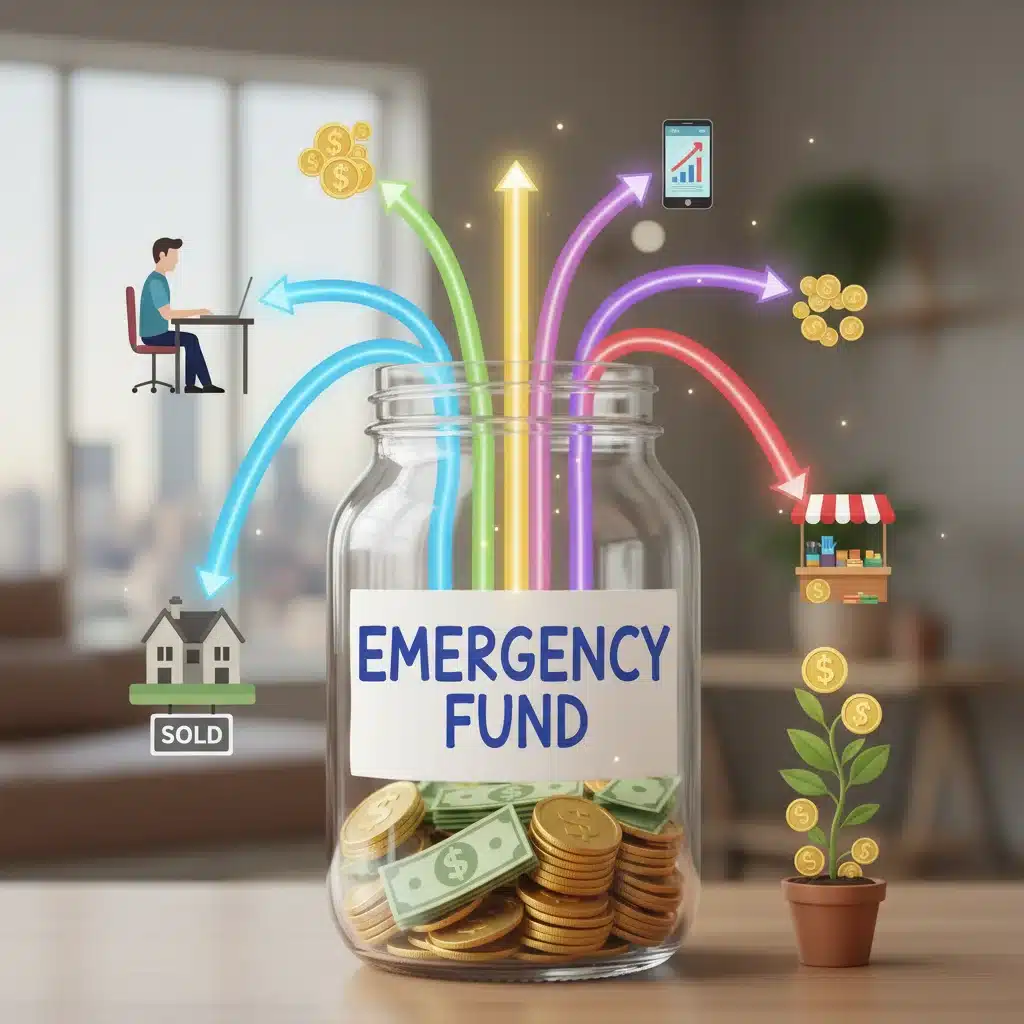
- Side Hustles: Explore opportunities like freelancing, dog walking, tutoring, driving for ride-sharing services, or selling crafts online. Even a few extra hundred dollars a month can significantly accelerate your savings.
- Sell Unused Items: Declutter your home and sell items you no longer need on platforms like eBay, Facebook Marketplace, or local consignment shops.
- Ask for a Raise: If you’re performing well at your current job, prepare a case for a raise.
- Overtime: If available and you have the capacity, taking on extra hours at work can provide a direct boost to your savings.
Windfalls and Bonuses:
Any unexpected money – tax refunds, work bonuses, gifts, or inheritance – should be directed straight into your emergency fund. Resist the temptation to spend it. These windfalls can provide a significant jumpstart or boost to your Emergency Fund Goal.
Step 4: Choose the Right Place for Your Emergency Fund
Where you store your emergency fund is almost as important as how much you save. The key criteria are safety, accessibility, and growth.
High-Yield Savings Accounts (HYSAs):
These are generally the best option. HYSAs offer significantly higher interest rates than traditional savings accounts, meaning your money grows (albeit slowly) while it sits there. They are also liquid, meaning you can access your funds quickly when needed. Look for FDIC-insured banks.
Money Market Accounts:
Similar to HYSAs, money market accounts often offer competitive interest rates and check-writing privileges, making them slightly more accessible. They are also FDIC-insured.
Avoid Investing Your Emergency Fund:
While investing can offer higher returns, it also comes with risk and less liquidity. Your emergency fund should not be subjected to market fluctuations. You need guaranteed access to the full amount when an emergency strikes, without the risk of your balance being down when you need it most. Keep investments separate for long-term growth.
Separate Account:
Keep your emergency fund in an account separate from your primary checking account. This creates a psychological barrier, making it less likely you’ll dip into it for non-emergencies. Out of sight, out of mind – in a good way!
Step 5: Monitor, Adjust, and Stay Motivated
Building an emergency fund is a marathon, not a sprint. Consistent monitoring and adjustment are vital to staying on track for your Emergency Fund Goal.
Regularly Review Your Progress:
Set a recurring calendar reminder to check your emergency fund balance and your overall budget each month. Celebrate milestones! Seeing your savings grow is incredibly motivating.
Adjust Your Budget as Needed:
Life happens. Your income might change, or new essential expenses might arise. Be flexible with your budget. If you overspend in one category, look for areas to cut back in the next month to stay on track with your savings goal.
Stay Disciplined:
The biggest challenge often lies in resisting the temptation to use your emergency fund for non-emergencies. Define what constitutes an emergency for you (e.g., job loss, medical crisis, essential home/car repair) and stick to it. If you dip into the fund, make it your absolute priority to replenish it immediately.
Visualize Your Goal:
Keep your December 2026 target in mind. Imagine the feeling of security and peace of mind that comes with having six months of expenses saved. Create a visual tracker, like a thermometer or a progress bar, to mark your advancements. Sharing your Emergency Fund Goal with a trusted friend or family member can also provide accountability and encouragement.
Overcoming Common Obstacles to Your Emergency Fund Goal
The path to a fully funded emergency account isn’t always smooth. You might encounter various challenges, but with foresight and strategy, you can overcome them.
Low Income:
If your income is genuinely low, finding extra money to save can feel impossible. In this situation, the focus shifts to two primary areas: increasing income (as discussed in Step 3) and ruthlessly cutting even more non-essential expenses. Even saving $50 or $100 a month is a start. Every dollar counts toward your Emergency Fund Goal. Also, explore government assistance programs or local charities if you’re struggling with basic needs.
High Debt:
Many people wonder if they should pay off high-interest debt (like credit cards) or build an emergency fund first. A common strategy is to save a mini-emergency fund ($1,000-$2,000) first. This protects you from going further into debt for small emergencies. Once that’s established, aggressively tackle high-interest debt. After the debt is paid, pivot back to fully funding your six-month emergency fund. This hybrid approach helps you manage both risks effectively.
Lack of Discipline:
This is a human challenge. If you struggle with discipline, automate everything possible. Make it hard to access your savings for impulse spending. Consider using a separate bank where it takes a few days to transfer funds back to your checking account. Find an accountability partner or use budgeting apps with built-in goals and reminders.
Unexpected Expenses While Saving:
It’s ironic, but sometimes emergencies happen while you’re building your emergency fund. If this occurs and you have to dip into your nascent fund, don’t get discouraged. Replenish it as quickly as possible. View it as a test run of your system and a reminder of why you’re saving in the first place.
Advanced Strategies to Accelerate Your Savings
Once you’ve got the basics down, consider these advanced tactics to reach your Emergency Fund Goal even faster.
The Snowball/Avalanche Method for Savings:
Similar to debt repayment strategies, you can apply these to savings. The ‘snowball’ method focuses on smaller, achievable savings goals first to build momentum. Once you hit a small target, you roll that motivation into the next, larger one. The ‘avalanche’ method prioritizes the largest potential savings first (e.g., cutting your most expensive discretionary category) to free up more cash faster.
No-Spend Challenges:
Try a ‘no-spend’ week or even a ‘no-spend’ month. This involves only spending money on absolute necessities. It’s an excellent way to reset your spending habits, identify hidden costs, and significantly boost your savings in a short period. All the money saved during these challenges goes directly to your Emergency Fund Goal.
The 52-Week Savings Challenge (Adjusted):
The traditional 52-week challenge involves saving increasing amounts each week. You can adapt this: start with an amount you’re comfortable with and increase it by a small, fixed amount each week. Or, save the same amount every week for 52 weeks. For example, saving $100 a week for 52 weeks yields $5,200 in a year.
Review and Optimize Big Ticket Items:
Beyond daily expenses, look at your larger recurring costs. Can you refinance your mortgage or car loan for a lower interest rate? Can you switch insurance providers for better rates? Are you paying too much for your cell phone plan or internet? These larger adjustments can free up substantial amounts of cash each month for your Emergency Fund Goal.
The Psychological Benefits of Achieving Your Emergency Fund Goal
Beyond the tangible financial security, having a fully funded emergency fund offers immense psychological benefits. It reduces stress and anxiety related to money, knowing you have a buffer against the unexpected. This peace of mind allows you to focus on other aspects of your life, whether it’s career development, family, or personal well-being. It empowers you to take calculated risks, knowing you have a safety net. It also provides a sense of accomplishment and control over your finances, fostering healthier financial habits in the long run.
Imagine the freedom of not having to worry about how you’ll pay for that unexpected car repair or medical bill. That freedom is priceless, and it’s precisely what your Emergency Fund Goal will deliver.
Conclusion: Your Path to Financial Resilience by December 2026
Building an emergency fund of six months’ living expenses by December 2026 is a significant undertaking, but it is entirely within your reach. It requires commitment, discipline, and a clear strategy. By meticulously calculating your target, understanding your spending habits, implementing aggressive saving and income-boosting strategies, and housing your funds wisely, you are setting yourself up for unparalleled financial security.
Remember, every dollar saved is a step closer to that ultimate peace of mind. Start today. Don’t wait for a crisis to realize the importance of an emergency fund. Take control of your financial future by prioritizing this essential financial safety net. The journey to achieving your Emergency Fund Goal by December 2026 begins with a single step, and with consistent effort, you will undoubtedly reach this crucial milestone, transforming your financial landscape for the better.