3-Month Budget Overhaul: Cut Expenses 20% by 2026

Anúncios
Are you tired of feeling like your money disappears faster than it comes in? Do you dream of a future where you have more control over your finances, where savings grow, and financial stress diminishes? The good news is that achieving financial freedom isn’t an impossible feat. With a strategic approach and consistent effort, you can transform your financial landscape. This comprehensive guide is designed to walk you through a powerful 3-Month Budget Overhaul, a step-by-step plan aimed at helping you cut your expenses by a significant 20% by 2026.
Many people shy away from budgeting, viewing it as restrictive or complicated. However, a budget is simply a tool – a roadmap that shows you where your money goes and helps you direct it towards your goals. And when it comes to cutting expenses, a focused, short-term overhaul can yield incredible results, setting you up for long-term financial success. We’re not talking about extreme deprivation; we’re talking about smart, sustainable changes that make a real difference.
Anúncios
The year 2026 might seem far off, but the decisions you make today, starting with this 3-Month Budget Overhaul, will lay the groundwork for your financial reality then. Imagine entering 2026 with 20% more disposable income, a healthier savings account, and a clear understanding of your financial habits. This guide will empower you to make that vision a reality.
Understanding the ‘Why’ Behind Your 3-Month Budget Overhaul
Before diving into the ‘how,’ it’s crucial to understand the ‘why.’ What are your financial goals? Do you want to pay down debt, save for a down payment, invest more, or simply reduce stress? Having a clear purpose will fuel your motivation throughout your 3-Month Budget Overhaul. Write down your top 3-5 financial goals. Make them specific, measurable, achievable, relevant, and time-bound (SMART goals).
Anúncios
For instance, instead of "I want to save money," aim for "I want to save $3,000 for a down payment on a car by December 2025." These tangible goals will serve as your north star, guiding your decisions and reminding you of the reward for your efforts during this budget overhaul.
The Power of a 20% Reduction
Why aim for a 20% expense reduction? While any reduction is beneficial, 20% is an ambitious yet achievable target that can significantly accelerate your financial progress. For someone spending $3,000 a month, a 20% reduction means an extra $600 – that’s $7,200 annually! This amount can be life-changing, allowing you to pay off credit card debt faster, bolster your emergency fund, or contribute more to retirement.
A 20% cut also forces you to look critically at every expense, distinguishing between needs and wants, and identifying areas where you might be overspending without realizing it. It’s a challenge that, once met, instills a profound sense of accomplishment and financial discipline.
Month 1: The Deep Dive & Initial Cuts
The first month of your 3-Month Budget Overhaul is all about discovery and initial action. This is where you gather all the data and make your first significant adjustments.
Step 1: Track Every Single Penny
This is non-negotiable. For the entire first month, meticulously track every dollar you spend. Use a budgeting app (like Mint, YNAB, or Personal Capital), a spreadsheet, or even a small notebook. The goal is not to judge your spending – yet – but simply to understand where your money is going. Many people are surprised to find out how much they spend on seemingly small, everyday items that add up quickly.
Categorize your expenses – housing, utilities, groceries, dining out, transportation, entertainment, subscriptions, personal care, etc. This detailed snapshot will be the foundation of your entire 3-Month Budget Overhaul.
Step 2: Identify Fixed vs. Variable Expenses
Once you have your spending data, differentiate between fixed and variable expenses:
- Fixed Expenses: These are usually the same amount each month – rent/mortgage, loan payments, insurance premiums, subscriptions.
- Variable Expenses: These fluctuate month-to-month – groceries, dining out, entertainment, clothing, utilities (to some extent).
While fixed expenses might seem harder to change, don’t overlook them. Sometimes there are opportunities to refinance loans, negotiate insurance rates, or cancel unused subscriptions.
Step 3: Immediate "Low-Hanging Fruit" Cuts
Armed with your spending data, it’s time for the first wave of cuts. Look for the "low-hanging fruit" – expenses that are easy to reduce or eliminate without significantly impacting your quality of life. This is a crucial part of your 3-Month Budget Overhaul.
- Unused Subscriptions: Do you really use all those streaming services, gym memberships, or app subscriptions? Cancel anything you don’t use regularly.
- Dining Out & Coffee: This is often a huge money sink. Commit to cooking more meals at home and brewing your own coffee. Even cutting back by half can save hundreds.
- Impulse Buys: Implement a "24-hour rule" for non-essential purchases. If you still want it after 24 hours, then reconsider.
- Negotiate Bills: Call your internet, cable, and phone providers. Ask for better rates or explore competitor offers. You’d be surprised what you can save.
Aim to hit at least 5-10% of your 20% goal in this first month through these initial cuts. Celebrate these small victories!
Month 2: Strategic Adjustments & Habit Formation
Month two of your 3-Month Budget Overhaul builds on the initial momentum. Now that you have a clearer picture of your spending, it’s time for more strategic adjustments and to start forming sustainable habits.
Step 1: Deep Dive into Variable Expenses
This is where you’ll find the bulk of your remaining 20% reduction. Review your variable expenses from Month 1 with a critical eye. Ask yourself:
- Groceries: Can I meal plan more effectively? Shop with a list? Buy generic brands? Reduce food waste?
- Transportation: Can I carpool, bike, or use public transport more often? Combine errands? Drive more efficiently?
- Entertainment: What free or low-cost alternatives can I explore? Game nights at home, free community events, library resources.
- Shopping (Clothing, Home Goods, etc.): Do I need this, or do I just want it? Can I buy second-hand? Wait for sales?
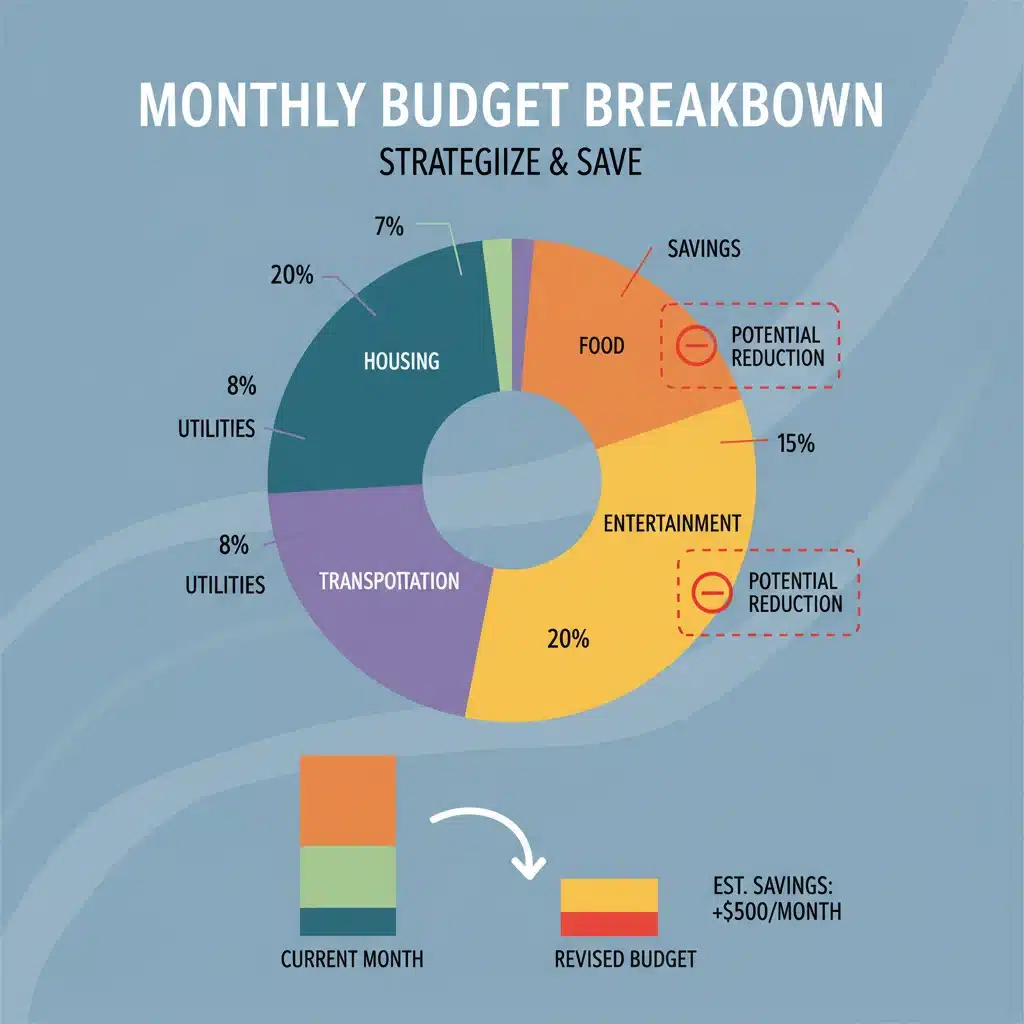
Set specific limits for each variable category. For example, if you spent $600 on groceries in Month 1, aim for $450-$500 in Month 2. This calculated reduction is key to your 3-Month Budget Overhaul success.
Step 2: Tackle Larger Fixed Expenses (If Applicable)
While often harder to change quickly, Month 2 is a good time to explore larger fixed expense reductions:
- Insurance: Get quotes from multiple providers for car and home insurance. You might find significant savings for the same or better coverage.
- Housing: This is a big one. While moving might not be feasible in 3 months, consider if you’re overpaying. If you have a spare room, could you get a roommate? Can you refinance your mortgage?
- Debt Payments: Explore debt consolidation or balance transfer options for high-interest credit card debt. Reducing interest rates can free up substantial cash flow.
Step 3: Implement the "Envelope System" (or Digital Equivalent)
For categories where you consistently overspend (e.g., dining out, entertainment, personal care), consider using the envelope system. Withdraw cash for these categories at the beginning of the month and only spend what’s in the envelope. When it’s gone, it’s gone. Digitally, you can achieve this by using separate bank accounts or budgeting app features that "allocate" funds to specific categories.
This method provides a tangible way to stick to your limits and is a powerful component of a successful 3-Month Budget Overhaul.
Month 3: Refinement, Automation & Long-Term Planning
You’re in the final stretch of your 3-Month Budget Overhaul! By now, you should have a much clearer picture of your spending, and you’ve likely already seen significant reductions. This month is about solidifying those changes, automating what you can, and thinking about the long game for 2026 and beyond.
Step 1: Review and Adjust Your Budget
Look back at your spending data from Months 1 and 2. How close did you get to your 20% reduction goal? Where did you succeed, and where did you struggle? Adjust your budget categories based on your real-world spending and the cuts you’ve implemented. This isn’t about perfection, but about continuous improvement and making your budget realistic and sustainable.
Perhaps you cut too much from one area and need to reallocate slightly. Or maybe you found an unexpected area where you can save even more. This iterative process is vital for the longevity of your 3-Month Budget Overhaul‘s impact.
Step 2: Automate Your Savings and Bill Payments
One of the most effective ways to ensure long-term financial success is to automate. Set up automatic transfers from your checking account to your savings and investment accounts on payday. Even small, consistent transfers add up significantly over time. Similarly, automate bill payments to avoid late fees and ensure you always pay on time.
This "pay yourself first" approach makes saving effortless and ensures that your hard-earned money is working for you, rather than just disappearing into daily expenses. Automation is a cornerstone of maintaining the positive changes from your 3-Month Budget Overhaul.
Step 3: Create a "Buffer" or "Miscellaneous" Category
No budget is perfect, and unexpected expenses will always arise. To prevent these from derailing your progress, create a small "buffer" or "miscellaneous" category in your budget. This allows for flexibility and prevents you from feeling defeated when something unexpected comes up. It’s about building resilience into your financial plan.
Step 4: Plan for Future Savings Goals
Now that you’ve successfully completed your 3-Month Budget Overhaul and cut expenses, channel those newfound savings towards your larger financial goals for 2026. Whether it’s building a robust emergency fund (aim for 3-6 months of living expenses), paying down high-interest debt, saving for a down payment, or investing for retirement, allocate your extra funds strategically. Seeing your savings grow will be a powerful motivator to continue your disciplined spending habits.
Maintaining Momentum Beyond the 3-Month Budget Overhaul
The 3-Month Budget Overhaul is a powerful sprint, but financial health is a marathon. To ensure the changes stick and you continue to reap the benefits, consider these long-term strategies:
Regular Budget Reviews
Don’t just set it and forget it. Schedule a monthly or quarterly "financial date" with yourself (or your partner) to review your budget, track your progress, and make any necessary adjustments. Life changes, and so should your budget.
Finding Free & Low-Cost Entertainment
Continue exploring ways to have fun without breaking the bank. Libraries offer books, movies, and sometimes even free passes to local attractions. Parks, hiking trails, and community events are often free. Host potlucks with friends instead of going out to expensive restaurants.
Mindful Spending
Cultivate a habit of mindful spending. Before every purchase, pause and ask yourself: "Do I truly need this? Does this align with my financial goals? Is there a cheaper alternative?" This simple practice can prevent countless impulse buys and keep your expenses in check long after your 3-Month Budget Overhaul is complete.
Increase Your Income
While this guide focuses on cutting expenses, remember that increasing your income is the other side of the financial coin. Could you take on a side hustle, freelance, negotiate a raise, or learn a new skill? More income means more money available for your goals, even with your reduced expenses.

Common Pitfalls and How to Avoid Them During Your 3-Month Budget Overhaul
Even with the best intentions, challenges can arise. Being aware of common pitfalls can help you navigate them successfully during your 3-Month Budget Overhaul.
- Burnout: Don’t try to cut everything at once. Small, consistent changes are more sustainable than drastic cuts that lead to feelings of deprivation. Allow yourself small, budgeted treats to avoid feeling too restricted.
- Comparison: Avoid comparing your financial journey to others. Everyone’s situation is unique. Focus on your own progress and celebrate your personal victories.
- Giving Up After a Slip-Up: You’re human. There will be times when you overspend or make an unplanned purchase. Don’t let one slip-up derail your entire effort. Acknowledge it, learn from it, and get back on track with your 3-Month Budget Overhaul.
- Lack of Flexibility: A rigid budget is a broken budget. Life is unpredictable. Build in some flexibility and be prepared to adjust your budget as circumstances change.
- Ignoring the "Why": Always keep your financial goals in mind. When motivation wanes, revisit why you started this 3-Month Budget Overhaul in the first place.
Conclusion: Your Path to Financial Freedom by 2026
Completing a 3-Month Budget Overhaul is more than just cutting expenses; it’s about gaining control, building financial literacy, and setting yourself on a powerful trajectory toward financial freedom. By meticulously tracking your spending, making strategic cuts, forming new habits, and automating your finances, you can realistically achieve a 20% reduction in expenses – a truly life-changing outcome.
The disciplined efforts you put in during these three months will not only save you money but also instill valuable financial habits that will serve you well for years to come. Imagine the peace of mind that comes with knowing where your money is going, having a healthy savings account, and being on track to meet your long-term financial goals by 2026 and beyond.
So, take the first step today. Start tracking, start cutting, and start building the financial future you deserve. Your 3-Month Budget Overhaul is your personal blueprint for a more secure and prosperous life. The power is in your hands to make 2026 your best financial year yet.