
Evaluating Financial Advisors 2026: 5 Key Questions to Ask
In an increasingly complex financial landscape, the role of a trusted financial advisor has never been more critical. As we look towards 2026, new economic realities, technological advancements, and evolving regulatory frameworks mean that the process of evaluating financial advisors requires a more discerning approach than ever before. Choosing the right advisor isn’t just about finding someone to manage your money; it’s about forming a partnership with a professional who understands your unique financial aspirations, navigates market volatility, and helps you build a secure future. This comprehensive guide will equip you with the five essential questions you must ask when evaluating financial advisors in 2026, ensuring you make an informed decision that aligns with your long-term goals.
Anúncios
The financial advice industry is dynamic, with various types of advisors offering a spectrum of services. From robo-advisors to traditional wealth managers, understanding the nuances of each can be daunting. However, armed with the right questions, you can cut through the noise and identify a professional who is not only competent but also genuinely committed to your financial well-being. This article delves into the core aspects of financial advisory services, from their qualifications and compensation to their investment philosophy and client communication, providing you with the tools to conduct a thorough and effective evaluation.
Whether you’re planning for retirement, saving for a major purchase, or looking to grow your wealth, the insights provided here will be invaluable. Let’s explore the critical questions that will guide you in evaluating financial advisors in 2026.
Anúncios
Question 1: What Are Your Qualifications, Credentials, and Experience?
When you’re entrusting someone with your financial future, their qualifications are paramount. The financial industry is replete with various certifications and designations, and understanding what each means can help you gauge an advisor’s expertise and ethical commitment. This question goes beyond simply asking about their degree; it delves into the depth of their professional development and their practical experience in navigating different market conditions.
Understanding Credentials and Certifications
Look for recognized certifications like Certified Financial Planner (CFP®), Chartered Financial Analyst (CFA®), or Personal Financial Specialist (PFS). Each of these signifies a rigorous standard of education, examination, experience, and ethical conduct. For instance, a CFP® professional has demonstrated expertise in financial planning topics, including investments, insurance, retirement planning, and estate planning. A CFA® charterholder specializes in investment management and research, often working with institutional clients or managing large portfolios. A PFS is a CPA with significant financial planning experience.
- Certified Financial Planner (CFP®): This is often considered the gold standard for personal financial planning. CFP® professionals are held to high ethical and professional standards, encompassing a broad range of financial topics.
- Chartered Financial Analyst (CFA®): Primarily focused on investment analysis and portfolio management. If your primary need is investment growth, a CFA® might be particularly relevant.
- Personal Financial Specialist (PFS): Offered by the AICPA, this designation combines tax expertise with financial planning knowledge, ideal for those with complex tax situations.
- Registered Investment Advisor (RIA): While not a certification, an RIA is a firm or individual registered with the SEC or state securities authorities. RIAs have a fiduciary duty to their clients, a crucial distinction we’ll discuss further.
The Importance of Experience
Beyond certifications, practical experience is invaluable. Ask about the advisor’s tenure in the industry, the types of clients they typically serve, and their experience navigating various economic cycles. Have they guided clients through bull markets and bear markets? How have they adapted their strategies during periods of high inflation or recession? An advisor with a proven track record across different market conditions will likely offer more robust and resilient advice.
Furthermore, inquire about their specialization. Some advisors focus on retirement planning, others on wealth accumulation for young professionals, and some on estate planning or business succession. Finding an advisor whose experience aligns with your specific financial needs is crucial for effective collaboration. When evaluating financial advisors, remember that a broad range of experience coupled with relevant specialization is often the ideal combination.
Question 2: How Are You Compensated, and What Is Your Fiduciary Duty?
Understanding an advisor’s compensation structure is critical because it directly impacts their potential conflicts of interest. This question is fundamental to assessing the objectivity of the advice you receive. Closely related is the concept of fiduciary duty, which dictates the legal and ethical standard an advisor must uphold.
Compensation Models Explained
Financial advisors typically operate under several compensation models:
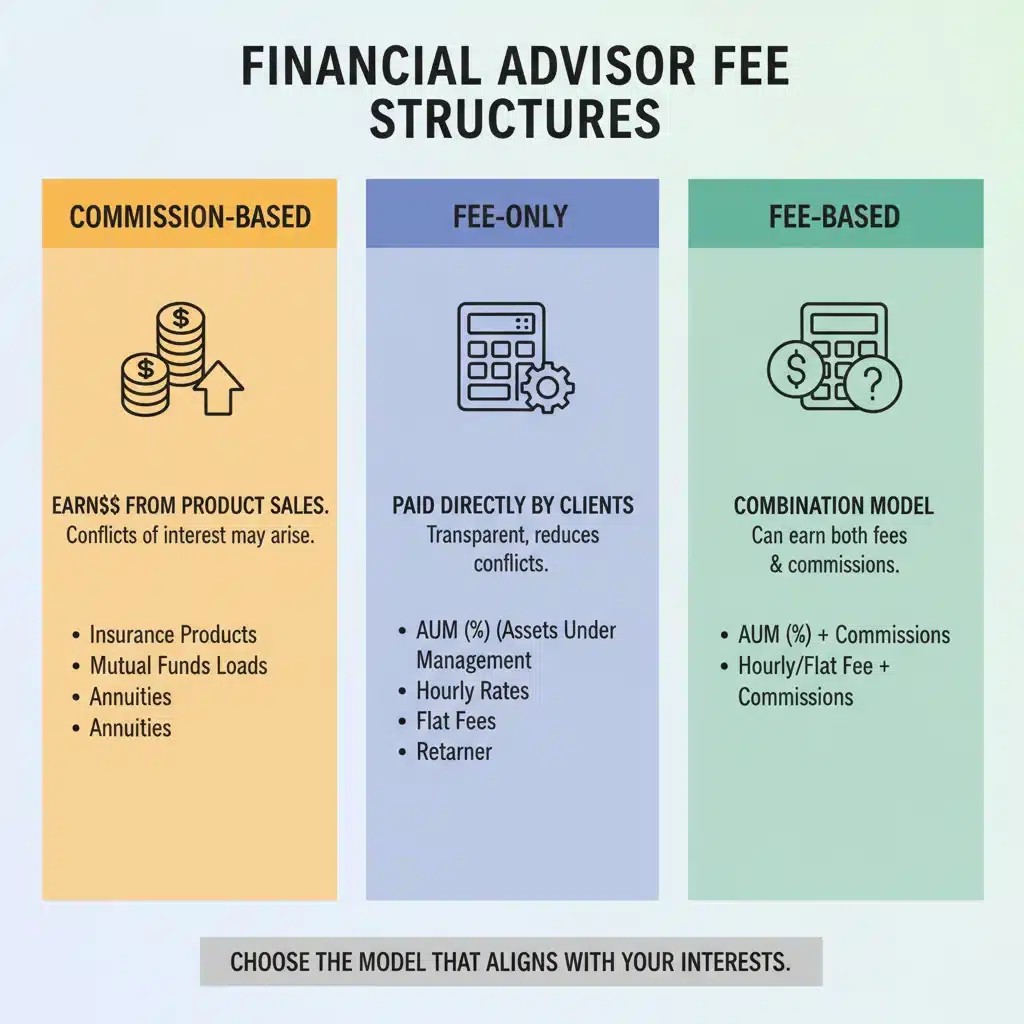
- Fee-Only: These advisors are compensated solely by the fees they charge clients, often based on a percentage of assets under management (AUM), an hourly rate, or a fixed fee for specific services. They do not earn commissions from selling financial products. This model generally minimizes conflicts of interest because their income is directly tied to the value they provide to you, not to product sales.
- Commission-Based: These advisors earn commissions when they sell financial products like mutual funds, annuities, or insurance policies. While they might offer valuable advice, there’s an inherent conflict of interest: they might be incentivized to recommend products that pay higher commissions, even if those aren’t the absolute best fit for your situation.
- Fee-Based: This is a hybrid model where advisors can charge fees (like AUM fees) AND earn commissions. While it offers more flexibility for the advisor, it also introduces potential conflicts of interest similar to commission-based models. It’s crucial to understand when and how they receive commissions.
When evaluating financial advisors, a fee-only advisor often provides the clearest alignment of interests with their clients, as their recommendations are less likely to be influenced by product sales. Always ask for a clear breakdown of all potential fees and charges.

The Fiduciary Standard vs. Suitability Standard
This is perhaps the most crucial distinction. A fiduciary advisor has a legal and ethical obligation to act in their clients’ best interests at all times, putting the client’s needs above their own. This is the highest standard of care in the financial industry. Registered Investment Advisors (RIAs) and CFP® professionals are typically held to a fiduciary standard.
In contrast, advisors operating under a suitability standard (common for brokers and those working for brokerage firms) are only required to recommend products that are ‘suitable’ for their clients, but not necessarily the absolute best option. This lower standard leaves room for conflicts of interest, as a suitable product might also be one that generates a higher commission for the advisor.
Always ask explicitly: "Are you a fiduciary?" And if so, "Are you always a fiduciary?" Some advisors may claim to be fiduciaries in certain capacities but not others (e.g., when providing financial planning advice vs. selling investment products). Clarity on this point is non-negotiable when evaluating financial advisors.
Question 3: What Is Your Investment Philosophy and Approach to Risk?
Your financial advisor’s investment philosophy should ideally resonate with your own financial goals and risk tolerance. A mismatch here can lead to discomfort, anxiety, and potentially suboptimal investment outcomes. This question helps you understand how they approach portfolio construction, asset allocation, and market fluctuations.
Understanding Their Investment Philosophy
Ask about their core beliefs regarding investing. Do they favor active management, trying to beat the market through stock picking and market timing? Or do they lean towards passive investing, utilizing low-cost index funds and ETFs to track market performance? Are they value investors, growth investors, or do they employ a diversified approach? Understanding their philosophy will give you insight into how your money will be managed.
Topics to discuss include:
- Diversification: How do they ensure your portfolio is adequately diversified across asset classes, geographies, and sectors?
- Long-term vs. Short-term: Do they focus on long-term growth and strategic asset allocation, or do they engage in more tactical, short-term adjustments?
- Rebalancing: How often and under what conditions do they rebalance portfolios to maintain target asset allocations?
- Ethical Investing (ESG): If socially responsible investing is important to you, inquire about their approach to Environmental, Social, and Governance (ESG) criteria.
Approach to Risk Management
Risk is an inherent part of investing, and a good advisor will have a clear and transparent approach to managing it. This starts with understanding your personal risk tolerance. How do they assess your risk profile? Do they use questionnaires, in-depth discussions, or a combination?
Beyond assessment, ask about their strategies for mitigating risk. This could include:
- Asset Allocation: How do they tailor asset allocation to your specific risk tolerance and time horizon?
- Hedging Strategies: Do they employ any hedging strategies to protect against downside risk?
- Emergency Funds: How do they integrate emergency fund planning into your overall financial strategy to reduce the need to liquidate investments during downturns?
- Behavioral Coaching: A crucial aspect is how they help clients avoid emotional decisions during market volatility. Do they educate clients on market cycles and the importance of staying the course?
An effective advisor will not only understand your risk tolerance but also help you manage your relationship with risk, ensuring your portfolio is structured to achieve your goals without causing undue stress. This is a critical component when evaluating financial advisors for a long-term partnership.
Question 4: What Services Do You Offer, and What Is Your Client Communication Style?
The scope of services an advisor provides and their communication approach are vital for a successful and lasting client relationship. You need to ensure their offerings match your needs and that their communication style fosters trust and transparency.
Range of Services
Financial advice can be comprehensive or specialized. Clarify what services are included in their standard offering and what might incur additional costs. Common services include:
- Financial Planning: This is a holistic approach covering budgeting, savings, debt management, retirement planning, education funding, and insurance needs.
- Investment Management: Managing your investment portfolio, including asset allocation, selection of securities, and ongoing monitoring.
- Retirement Planning: Specific strategies for accumulating and drawing down retirement assets, including Social Security optimization.
- Estate Planning: Guidance on wills, trusts, and wealth transfer strategies (though they may recommend an estate attorney for legal documents).
- Tax Planning: Strategies to minimize tax liabilities (again, often in conjunction with a tax professional).
- Insurance Analysis: Reviewing existing policies and recommending appropriate coverage (life, disability, long-term care).
- Cash Flow Management: Helping you understand and optimize your income and expenses.
Ensure the advisor’s service offering aligns with your current and anticipated future needs. If you only need investment management, a comprehensive financial planner might be overkill, and vice-versa. When evaluating financial advisors, specificity about services prevents misunderstandings down the line.
Client Communication and Accessibility
Effective communication is the bedrock of any successful advisory relationship. Ask about their communication protocols:
- Frequency of Contact: How often do they typically meet with clients (annually, semi-annually, quarterly)? Are there regular portfolio reviews?
- Preferred Communication Channels: Do they primarily communicate via email, phone, video calls, or in-person meetings?
- Responsiveness: What is their typical response time for client inquiries? How do they handle urgent questions?
- Reporting: What kind of reports do they provide (performance reports, financial plan updates)? How detailed are these reports, and how often are they issued?
- Team Approach: Will you be working with a single advisor, or will there be a team supporting you? If a team, who will be your primary point of contact?
A good advisor should be proactive in communicating, especially during significant market events or changes in your personal financial situation. Transparency in communication, including explaining complex financial concepts in an understandable way, is a hallmark of a valuable partnership. This aspect is often overlooked but becomes incredibly important when you are evaluating financial advisors for a long-term commitment.
Question 5: Can You Provide References, and How Do You Handle Client Turnover?
While not always possible, asking for references can provide invaluable insights into an advisor’s client relationships and service quality. This question also probes into their stability and the longevity of their client base, which speaks volumes about their performance and client satisfaction.
Seeking References and Testimonials
Due to privacy regulations, advisors may not always be able to provide direct client references. However, they should be able to provide testimonials or direct you to review sites where their clients have shared their experiences. Look for consistent themes in positive feedback, such as clear communication, personalized advice, and a strong understanding of client needs. If they can provide references (with client permission), be sure to ask the references about:
- Their overall satisfaction with the advisor.
- How well the advisor understands their financial goals.
- The advisor’s communication style and responsiveness.
- How the advisor has helped them navigate challenging market conditions.
- Any aspects they believe the advisor could improve upon.
Even if direct references aren’t available, an advisor should be able to share case studies (anonymized) or examples of how they’ve helped clients with situations similar to yours. This demonstrates their practical problem-solving skills and relevance to your needs. This due diligence is crucial when evaluating financial advisors.
Understanding Client Turnover and Longevity
Ask about their client retention rates and how they handle client turnover. A high client retention rate often indicates client satisfaction and consistent value delivery. Conversely, high turnover might signal issues with service, performance, or communication.
Inquire about their process for onboarding new clients and their strategy for retaining existing ones. A well-defined client journey, from initial consultation to ongoing reviews, suggests a structured and client-centric approach. Also, consider the advisor’s own long-term plans. Are they nearing retirement? Do they have a succession plan in place to ensure continuity of service? For a long-term financial partnership, you want an advisor who will be there for the journey, or at least has a clear plan for transitioning your account smoothly if they depart.
This question helps you assess the stability of the advisory relationship and the advisor’s commitment to long-term client care. It’s an often-overlooked but vital part of successfully evaluating financial advisors.
Beyond the Five Questions: Additional Considerations for 2026
While the five core questions form a robust framework, the financial landscape of 2026 presents additional aspects to consider when selecting an advisor.
Technological Integration
How does the advisor leverage technology? Do they offer a client portal for easy access to statements and financial plans? Do they use advanced analytical tools for portfolio performance tracking and scenario planning? In an increasingly digital world, technological capabilities can significantly enhance the client experience and the efficiency of financial planning.
Cybersecurity Measures
With the rise of cyber threats, inquire about the advisor’s cybersecurity protocols. How do they protect your sensitive financial and personal data? What measures are in place to prevent data breaches? This is a non-negotiable aspect of modern financial advisory services.
Team Structure and Support
Understand the entire team that will be supporting you. Is there a dedicated client service team? Who handles administrative tasks? Knowing the structure ensures you understand who to contact for different needs and that there’s adequate support beyond your primary advisor.
Regulatory Compliance and Disclosures
All Registered Investment Advisors (RIAs) are required to provide clients with a Form ADV Part 2 (often called a ‘brochure’), which details their services, fees, conflicts of interest, and disciplinary history. Always ask for and read this document carefully. It provides transparency that is legally mandated and incredibly useful when evaluating financial advisors.
Personal Chemistry and Trust
Finally, and perhaps most importantly, consider the personal chemistry. Do you feel comfortable speaking openly and honestly with the advisor? Do they listen attentively and understand your concerns? Trust is foundational to a successful financial advisory relationship. No matter how qualified an advisor is, if you don’t feel a strong sense of trust and rapport, the partnership may struggle.
Conclusion: Making an Informed Choice for Your Financial Future
Choosing a financial advisor is a significant decision that can profoundly impact your financial well-being. By diligently asking these five crucial questions – and considering the additional factors for 2026 – you can move beyond surface-level impressions and conduct a thorough evaluation. The process of evaluating financial advisors is not just about finding someone with good investment returns; it’s about identifying a trusted partner who aligns with your values, understands your unique circumstances, and is committed to helping you achieve your long-term financial goals.
Take your time, interview multiple candidates, and don’t hesitate to ask follow-up questions. Your financial future deserves careful consideration and the expertise of a professional who genuinely has your best interests at heart. In 2026 and beyond, a well-chosen financial advisor can be an invaluable asset, providing guidance, clarity, and peace of mind as you navigate your financial journey.